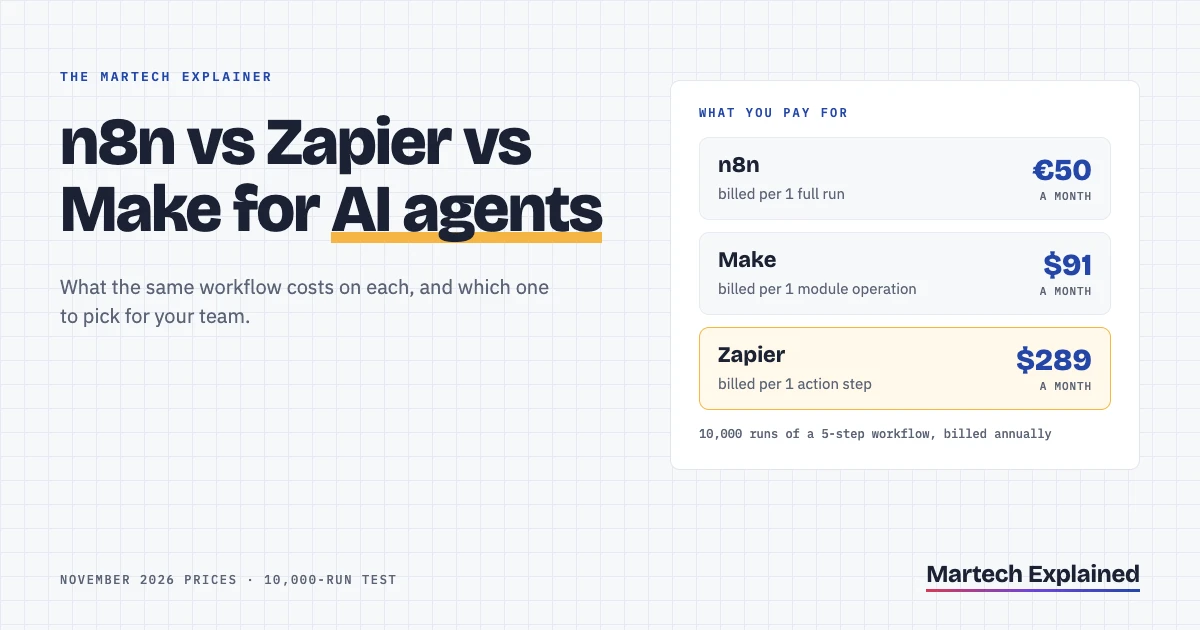
n8n vs Zapier vs Make comes down to volume, skills and control. Zapier is the easiest to start and connects the most apps, but it costs the most at scale. Make is the cheapest hosted option per step. n8n charges per full run and can be self-hosted, which makes it the best fit for AI agents running at volume.
All three now sell AI agent features, so the choice matters more than it did a year ago. An agent loop can call several tools in a single run, and each platform bills those calls differently. This guide prices the same workflow on all three, then compares the agent features, ease of use and data control. If you’re new to agents, start with what agentic marketing is.
n8n vs Zapier vs Make in 30 seconds
- The same 5-step workflow run 10,000 times a month costs €50 a month on n8n Cloud Pro, $91 on Make and $289 on Zapier Professional, all billed annually.
- n8n counts 1 execution per run, however many steps. Zapier counts 1 task per action step. Make counts 1 credit per module operation.
- Zapier connects to 9,000+ apps, Make to 3,500+ and n8n lists 2,000+ integrations.
- Only n8n can be self-hosted. Its Community edition is free for internal business use.
- Prices checked on vendor sites in November 2026. AI model tokens are extra on all three.
Table of Contents
n8n vs Zapier vs Make: the quick verdict
n8n vs Zapier is the most common comparison, but Make belongs in it too. Here is the one-line verdict for each:
- Zapier: pick it if your team is non-technical, needs a niche app connector, or runs under a few thousand tasks a month.
- Make: pick it if you want a visual builder, branching logic and the lowest hosted price per step, with an EU data center option.
- n8n: pick it if you run AI agents at volume, want approval steps on agent tool calls, or need to keep data on your own servers.
How this comparison was made: every price, limit and feature comes from each vendor’s pricing page and documentation, checked in November 2026. The cost example below is a worked calculation from those published rates, not a bill from a live account. There are no affiliate links in this post.
| n8n | Zapier | Make | |
|---|---|---|---|
| Billing unit | Execution (1 full run) | Task (1 action step) | Credit (1 module operation) |
| Free plan | Self-hosted Community edition | 100 tasks a month, two-step Zaps | 1,000 credits a month |
| Entry paid plan | Starter: €20 a month for 2,500 executions | Professional: $19.99 a month for 750 tasks | Make Plan: $9 a month for 5,000 credits |
| AI agents | AI Agent node, all plans | Zapier Agents, separate activity allowance | Make AI Agents (beta), all plans |
| App integrations | 2,000+ | 9,000+ | 3,500+ |
| Self-hosting | Yes | No | No |
| Data location | Your server, or n8n Cloud | AWS in the United States | US or EU, chosen at sign-up |
How much does each platform cost for 10,000 runs?
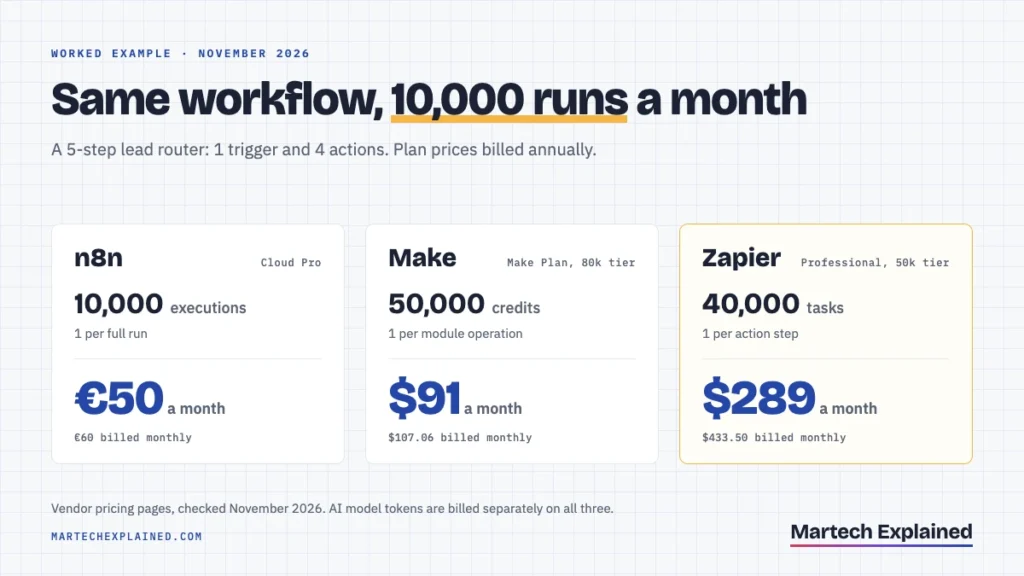
For 10,000 runs a month of a typical 5-step workflow, n8n Cloud costs €50 a month, Make $91 and Zapier $289, all billed annually. The gap comes from what each platform counts as one billable unit, not from the headline plan price.
The example workflow is a lead router many B2B teams run. A form submission triggers it. Then it enriches the lead, asks an AI model to classify it, creates the contact in the CRM and posts an alert to Slack. That’s 1 trigger plus 4 actions, run 10,000 times a month.
- n8n: one execution is “a single run of your entire workflow”, whatever the number of steps (n8n pricing). So 10,000 runs use 10,000 executions.
- Zapier: each successful action step uses 1 task, and trigger steps are free (Zapier Help Center). Four actions mean 4 tasks a run, or 40,000 a month.
- Make: the trigger uses 1 credit per run and each action uses 1 credit per item it processes (Make Help Center). That’s 5 credits a run, or 50,000 a month.
| 10,000 runs a month | n8n | Zapier | Make |
|---|---|---|---|
| Units used | 10,000 executions | 40,000 tasks | 50,000 credits |
| Plan that covers it | Cloud Pro (10,000 executions) | Professional, 50,000-task tier | Make Plan, 80,000-credit tier |
| Billed annually | €50 a month | $289 a month | $91 a month |
| Billed monthly | €60 a month | $433.50 a month | $107.06 a month |
| Self-hosted | €0 licence, plus your server | Not offered | Not offered |
Three things change the math for your own workflows:
- Loops cost more on Zapier and Make. If a run processes 20 rows, Zapier and Make bill each row’s actions. n8n still counts one execution.
- Filters and routers are free on Zapier and Make. Zapier doesn’t count Filter, Paths or Formatter steps, and Make doesn’t count routers or filters. A workflow heavy on logic costs less than its step count suggests.
- Short, simple Zaps are where Zapier holds up. At 750 tasks a month, Zapier Professional costs $19.99 billed annually, close to n8n Starter’s €20.
On overages, Zapier switches you to pay-per-task at a higher rate once you pass your tier, up to 3 times your plan’s task limit, unless you turn it off. Make stops running scenarios when credits run out, and lets you buy extra credits in bundles of 1,000 or 10,000 (Make pricing).
Which platform is best for building AI agents?
n8n is the strongest of the three for building AI agents, because an agent’s tool calls happen inside one execution and you can require human approval before specific tools run. Zapier is the fastest way to get a simple agent working. Make’s agents are labelled beta on its pricing page.
If you’re still deciding whether a task needs an agent at all, read AI agents vs rule-based automation first. Most marketing workflows need one AI step inside fixed rules, not a fully autonomous agent.
n8n AI Agent node
- How it works: you connect a chat model and at least one tool, and the agent decides which tools to call to finish the task (n8n docs).
- Approvals: the workflow can pause before a tool runs, and a reviewer approves or denies it in Slack, Microsoft Teams, Gmail, Outlook, Telegram or n8n Chat (n8n docs).
- MCP: an MCP Client node lets agents use outside MCP servers, and an MCP Server Trigger exposes your workflows to AI assistants. Both are on every plan.
- Cost of agent loops: no extra platform charge. You pay your model provider for tokens.
Zapier Agents
- How it works: you describe the agent’s job in plain language, and it acts in your connected apps, browses the web and reads attached knowledge.
- Pricing: billed in activities, separate from Zap tasks. The free plan includes 400 activities a month. Agents Pro is $33.33 a month billed annually for 1,500 activities (Zapier pricing).
- MCP: Zapier MCP lets Claude, ChatGPT and other AI clients run actions in your apps. Each successful tool call uses 2 tasks from your Zap quota (Zapier MCP).
- The catch: agents and Zaps draw on two different meters, so a busy setup means watching both.
Make AI Agents
- How it works: you build and manage agents in the same visual canvas as your scenarios. Make lists them as beta and available on all plans.
- Model choice: use Make’s built-in AI Provider on any plan, or your own OpenAI, Anthropic or Gemini key on paid plans.
- Pricing: with your own key, an agent uses 1 credit per operation. With Make’s AI Provider, it also uses credits based on tokens (Make Help Center).
- MCP: the Make MCP Server is included on every plan, including Free. You pay only for credits the called scenarios use.
For a plain-English explanation of the protocol all three now support, see the Model Context Protocol (MCP) guide for marketers. For agents sold as finished products rather than built, see the best AI agents for marketing teams.
Which is easiest to use: n8n, Zapier or Make?
Zapier is the easiest of the three for non-technical marketers, Make sits in the middle, and n8n asks the most of you. All three now let you describe a workflow in plain language and have AI draft it.
- Zapier: builds steps top to bottom in a single column, which is easy to read. Zapier Copilot drafts Zaps from a prompt.
- Make: builds on a visual canvas where modules connect like a flowchart, so branches and loops are easy to see. Maia by Make builds and debugs scenarios from a conversation.
- n8n: also uses a node canvas, but you’ll meet data structures and expressions sooner. Cloud plans include credits for the n8n Assistant, which is still in preview.
Speed limits differ too. Zapier’s free plan checks for new data every 15 minutes, Professional every 2 minutes and Team every minute. Make’s free plan runs scenarios at most every 15 minutes, and the paid Make Plan every minute. A single n8n run can last up to 5 minutes on Starter and 40 minutes on Pro.
Which has more integrations?
Zapier has the most integrations: it connects to 9,000+ apps (Zapier apps). Make lists 3,500+ apps, and n8n lists 2,000+ integrations on its directory (n8n integrations).
The raw count matters less than whether your specific tools are covered, with the actions you need. Check your five most-used tools in each directory before you choose. All three can also call any tool with an API: Zapier through webhooks, Make through custom apps and HTTP modules, and n8n through its HTTP Request node.
Can you self-host n8n, Zapier or Make?
Only n8n can be self-hosted. Zapier and Make run in their own clouds, so your workflow data passes through their servers.
- n8n: the Community edition runs on your own server with Docker. Its Sustainable Use License allows use “only for your own internal business purposes or for non-commercial or personal use” (n8n licence). You can’t resell it as a hosted service. The self-hosted Business plan, with SSO and Git version control, costs €667 a month billed annually.
- Zapier: stores data on Amazon Web Services in the United States, and says it doesn’t train AI on the data in your workflows (Zapier security).
- Make: lets you choose a US or EU data center when you create your organization. You can’t change it later (Make Help Center). Enterprise adds an on-prem agent for reaching systems on your local network.
Self-hosting moves cost and control to you. You save the subscription, but updates, backups and security patches become your job. For a small marketing team with no engineering help, n8n Cloud is usually the better start.
Which should you choose?
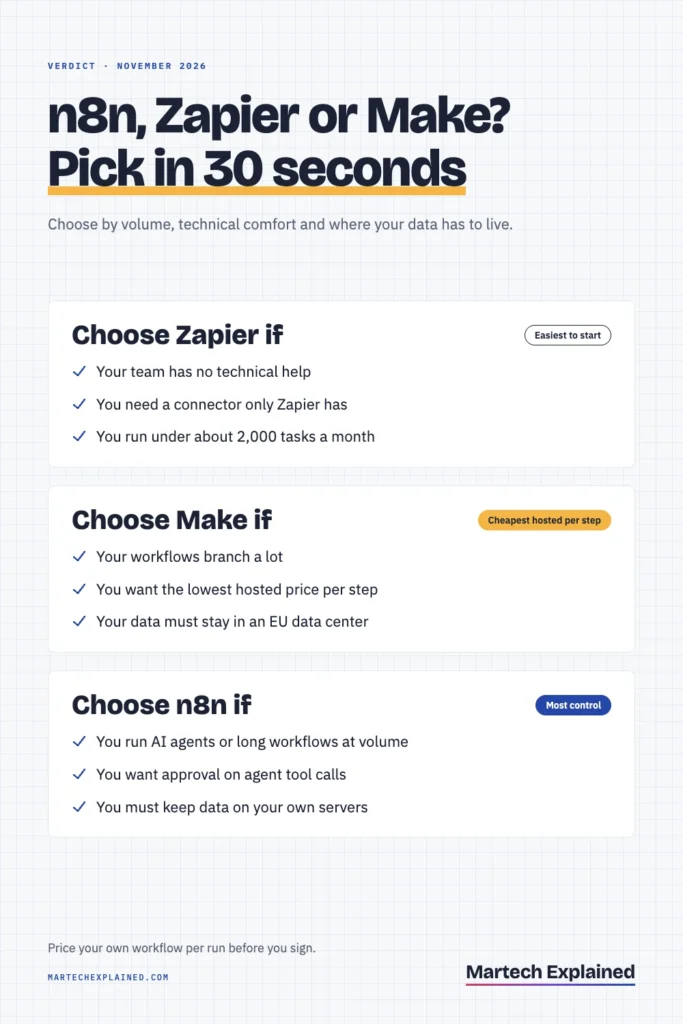
Choose by your monthly volume, your team’s technical comfort and where your data has to live. Use these rules as a starting point:
- Choose Zapier if your team has no technical help, you need a connector only Zapier has, or you run under about 2,000 tasks a month.
- Choose Make if your workflows branch a lot, you want the lowest hosted price per step, or your data must stay in an EU data center.
- Choose n8n if you run AI agents or long workflows at volume, want approval steps on agent tool calls, or must keep data on your own servers.
- Price your own workflow before you sign. Count steps per run and runs per month, then apply each platform’s billing unit, as in the table above.
For the basics these platforms sit on, see what marketing automation is and how triggers, conditions and actions fit together.
Frequently asked questions
Is n8n cheaper than Zapier?
n8n is cheaper than Zapier for multi-step workflows at volume, because n8n bills per full run and Zapier bills per action step. A 5-step workflow run 10,000 times a month costs €50 on n8n Cloud Pro and $289 on Zapier Professional, billed annually (November 2026). For a few hundred simple tasks a month, the two cost about the same.
Is n8n free?
The n8n Community edition is free to self-host for internal business, personal or non-commercial use. You still pay for the server and your AI model tokens. n8n Cloud starts at €20 a month billed annually, with a free trial that needs no credit card.
Is Make better than Zapier?
Make is better than Zapier on price per step and on visual branching logic. Zapier is better on app coverage, with 9,000+ apps against Make’s 3,500+, and on ease of use for non-technical teams. Pick Make if cost and complex logic matter most, and Zapier if speed of setup does.
Can Zapier build AI agents?
Yes. Zapier Agents let you describe a job in plain language, and the agent acts across your connected apps. Agents are billed in activities, separate from Zap tasks, with 400 free activities a month.
Do n8n, Zapier and Make charge for AI tokens?
If you connect your own OpenAI, Anthropic or Gemini key, you pay that provider for tokens and the platform charges only its normal unit. Make’s built-in AI Provider and Zapier’s AI features use extra credits or tasks based on the model. Check each platform’s rate page before a high-volume AI workflow goes live.
Which is best for a non-technical marketer?
Zapier is the best fit for a non-technical marketer. Its step-by-step builder is the easiest to follow, and it covers the most apps. Move to Make or n8n when your task bill grows or your workflows need heavy branching.
The bottom line
Start on Zapier if you need something working today, move to Make when step costs start to bite, and pick n8n when AI agents and data control matter most. Whatever you choose, price your own workflow per run before you commit.
Next in this series: What Is GEO? Generative Engine Optimization Explained.
Get the next guide in your inbox
One email a week: the new guides, one tool worth knowing and one number that matters.
Sources
- n8n plans and pricing, n8n, checked November 2026
- AI Agent node, n8n documentation, checked November 2026
- Human-in-the-loop for AI tool calls, n8n documentation, checked November 2026
- Sustainable Use License, n8n on GitHub, checked November 2026
- n8n integrations, n8n, checked November 2026
- Zapier plans and pricing, Zapier, checked November 2026
- How is task usage measured in Zapier?, Zapier Help Center, November 2026
- Zapier MCP and Zapier app directory, Zapier, checked November 2026
- Security and compliance, Zapier, checked November 2026
- Make pricing, Make, checked November 2026
- How features use credits and Credit usage for AI agents, Make Help Center, checked November 2026
- Organizations, Make Help Center, October 2026