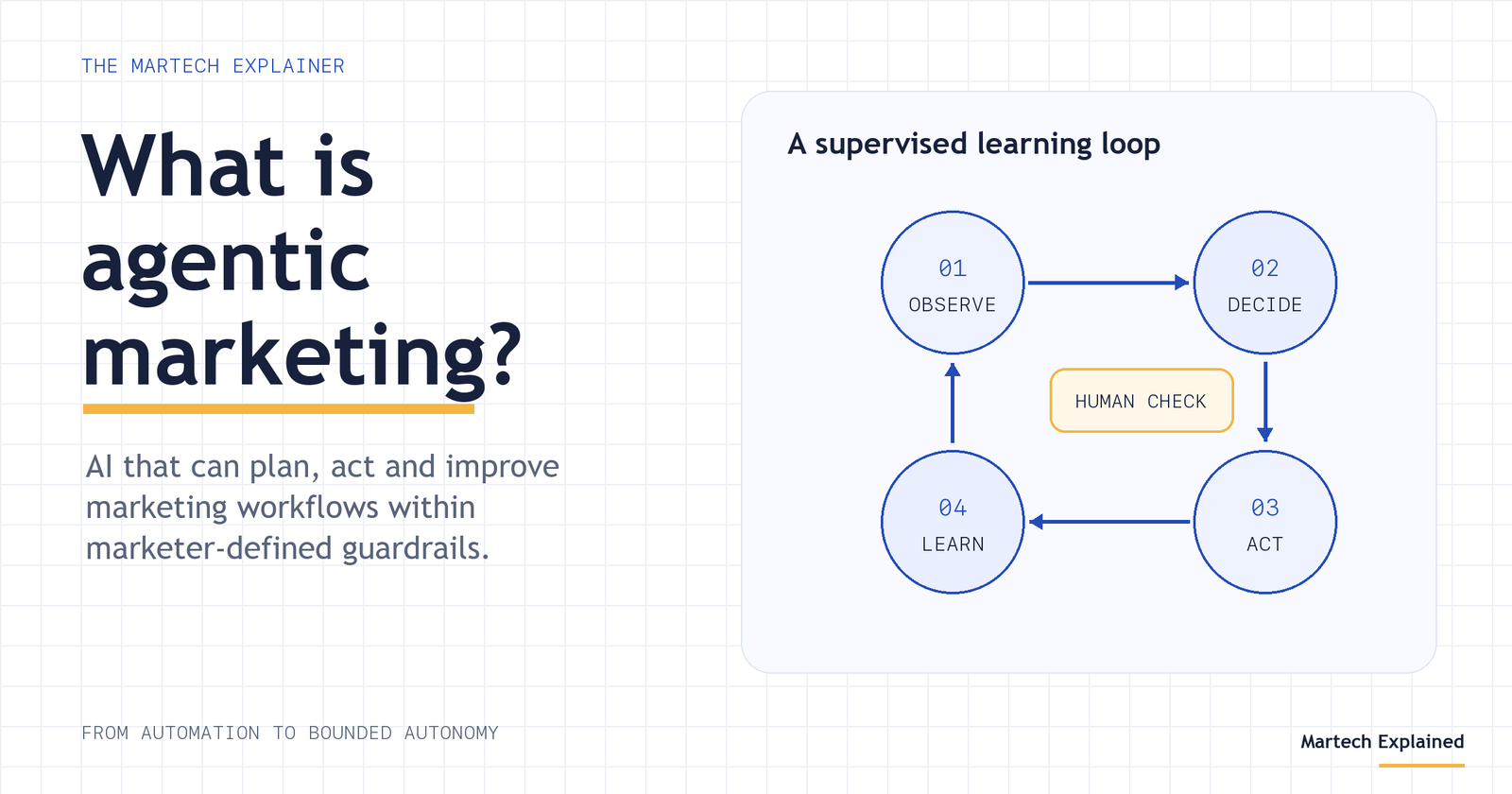
Agentic marketing uses AI agents to work toward a marketing goal: interpret the context, choose among approved actions, use connected tools, and check what happened. It sits between text-generation assistants and rule-based automation. In practice, it means bounded decision-making inside a marketing workflow, with human review where an action can affect customers, money, data, or brand trust.
The word “agent” now appears on chatbots, workflow tools, and software that can take action. The useful question is what the system can decide and do for itself. This guide separates the capability from the label, maps an autonomy ladder, and shows where marketing teams can start safely.
If you are new to the wider category, start with what martech is. Agentic marketing is one emerging way that AI can work inside the tools marketers already use.
This guide in 30 seconds
- Agentic marketing gives an AI system a goal, context, approved tools, and room to choose its next step.
- A generated answer or a fixed automation is useful, but neither is automatically an AI agent.
- Most teams should begin with an assistant or human-approved copilot, then expand autonomy only when tests support it.
- Research, campaign QA, lead triage, and reporting are promising starting tasks when data and success criteria are clear.
- Keep permissions narrow. Require approval for customer-facing messages, spend, sensitive data, and irreversible changes.
In this guide
Table of Contents
What is agentic marketing?
Agentic marketing is the use of AI agents to complete marketing tasks by pursuing a defined goal, choosing from available actions, and adjusting to what happens. A marketer sets the goal and boundaries. The agent handles some of the steps in between.
For example, a reporting agent might be asked to find campaigns whose cost per qualified lead rose above a set threshold. It could query approved campaign data, compare results with the threshold, inspect the affected campaigns, and return a short list with suggested next steps. A person can then decide whether to change a bid, pause an ad, or investigate tracking.
The model alone is not the whole agent. A working system also needs instructions, data access, tools, limits, and a way to check its result. OpenAI describes agents as systems that independently accomplish tasks for users. Anthropic draws a distinction between fixed workflows, where people define the path, and agents, which can decide how to proceed using tools and feedback.
There is no single industry-wide line for what counts as an agent. Some products use the word for narrow assistants; others mean systems that can act over several steps. For this guide, an AI agent for marketing must be able to select and carry out at least some steps toward a goal. If a person chooses every action, the system may still be useful, but the person is operating the workflow. The martech glossary has a one-line definition.
Current adoption figures need context. In the “Martech for 2026” survey, 90.3% of participants said they used agents somewhere in their martech stack. That included experiments and limited production use. The report authors noted that respondents skewed more tech-savvy than the average marketing team. Adobe’s separate 2026 survey found that only 13% of organizations had embedded agentic AI across brand discovery and search. These figures describe different samples and questions, but both point to a gap between trying agents and running them broadly.
| Evidence | Finding | How to read it |
|---|---|---|
| AI & Data in Marketing survey, reported in “Martech for 2026” | 90.3% of participants used AI agents somewhere in their martech stack. | “Somewhere” included experimentation and limited production. The authors said the sample was more tech-savvy than average. |
| Adobe 2026 AI and Digital Trends survey | 13% reported organization-wide agentic AI for brand discovery and search; 16% for customer support. | A survey of customer-experience leaders and practitioners, not only marketing teams. Most surveyed workflows had no active agentic AI use. |
| Gartner forecast, June 2025 | Gartner predicted that more than 40% of agentic AI projects would be canceled by the end of 2027. | This is a forecast, not a measured cancellation rate. Gartner cited cost, unclear value, and inadequate risk controls. |
The practical takeaway is to judge an agent by the job it completes and the controls around it. “Autonomous marketing” does not have to mean a system running campaigns without oversight. Most teams can begin with one narrow task and a human approval step.
Generative AI vs AI agents
Generative AI produces an answer, image, or other output from an instruction. An AI agent can use a model as part of a longer process: it may gather information, choose a tool, take an action, inspect the result, and decide what to do next.
A single tool call does not automatically make a system agentic. The useful distinction is whether the system can decide what step to take based on the goal and the information it receives, within limits set by people.
| System | Who chooses the next step? | Marketing example |
|---|---|---|
| Generative AI assistant | The marketer prompts, reviews, and decides what to do next. | Draft five subject lines for a campaign. |
| Rule-based automation | A person defines the conditions and the fixed actions in advance. | If a contact downloads a guide, wait two days and send a follow-up email. |
| AI agent | The agent chooses from approved steps based on the goal and what it learns. | Review campaign results, find a likely tracking issue, and prepare a QA report. |
| Multi-agent system | Several agents perform specialized tasks under shared orchestration and controls. | One agent gathers campaign data, another checks the landing page, and a coordinator combines the findings. |
Rule-based automation remains the right tool for repeatable tasks with clear conditions. It is easier to audit and usually more predictable. Agents are useful when a task has several possible paths, information arrives in different formats, or the next step depends on what the system finds. For how rule-based workflows are built, see what marketing automation is.
That flexibility also brings variation. A workflow can be tested against its defined branches. An agent may take different routes on different attempts, so teams need to test the final outcome and the actions taken along the way. The same lead follow-up built both ways is in AI agents vs automation.
Use deterministic code for tasks that require exact calculations or hard limits. A model can summarize why a campaign changed, but code should enforce its maximum budget, frequency cap, audience exclusions, and consent rules.
The autonomy ladder
Agentic marketing is easier to evaluate as a ladder of increasing decision rights. The four levels below move from assistance to systems that coordinate several agents. A higher rung gives the system more room to act. It does not guarantee better work.
| Level | What the system does | What the marketer controls | Example |
|---|---|---|---|
| 1. Assist | Completes one task after a prompt. | The marketer selects the task, checks the output, and takes every action. | Summarize a campaign report and suggest three follow-up questions. |
| 2. Copilot | Helps through several steps while the marketer directs and approves each important move. | The marketer chooses the path and remains present during execution. | Review a draft campaign, flag missing links, and prepare a checklist for approval. |
| 3. Agent | Receives a defined goal, selects from approved tools, and completes bounded actions or returns for approval. | The team sets permitted data, actions, thresholds, and stop conditions. | Check a campaign against a launch checklist, fix safe metadata errors, and request approval before sending. |
| 4. Multi-agent | Several specialist agents hand work to one another under shared coordination. | The team defines roles, data access, handoffs, ownership, and the overall approval path. | Separate research, analytics, and QA agents prepare a campaign review for a marketer. |
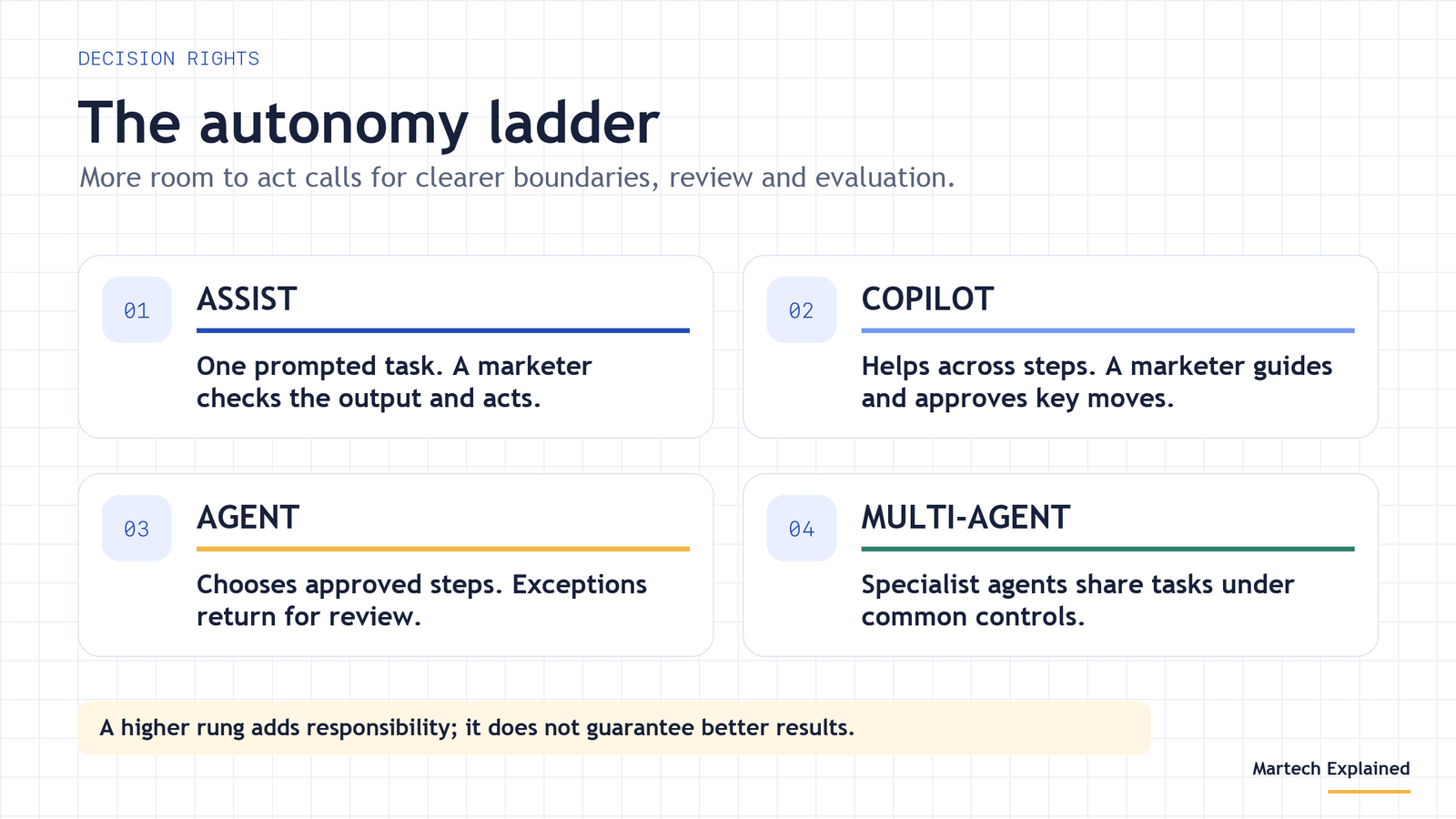
The boundary between copilot and agent depends on the task. If the system only drafts a plan and waits, it is acting as a copilot. If it chooses among allowed steps and executes some of them, it is acting as an agent. A system can also move between levels: it might act independently on low-risk checks and ask for approval before changing campaign settings.
Multi-agent design is an architectural choice, not a maturity badge. It can help when work divides naturally into distinct tasks and each agent has a clear role. It can also add more handoffs, permissions, and failure points. Start with one agent unless the task genuinely needs separate specialists.
Before moving up a rung, ask four questions:
- Can you define a good result clearly enough to test it?
- Can you limit the tools and data the system can access?
- Can a person review or reverse the action if it is wrong?
- Do you know the cost and time per completed task?
If any answer is no, keep the system lower on the ladder until the gap is fixed.
Marketing use cases that can work today
The best early use cases are bounded tasks with accessible data, a clear definition of success, and a person who can review the result. These agentic AI examples are starting points to test, not claims that every team should automate them.
| Task | What an agent could do | Keep a person responsible for | Useful measure |
|---|---|---|---|
| Campaign research | Gather approved performance data, summarize changes, and list questions for the campaign owner. | Choosing the strategy, validating sources, and deciding what the team should do. | Time to produce a checked campaign review; error rate in cited figures. |
| Campaign QA | Check links, naming, missing fields, and launch requirements against a defined checklist. | Approving the final send, audience, and any exceptions to policy. | Issues caught before launch; false alarms; missed critical errors. |
| Lead or intent triage | Combine approved CRM signals into a concise handoff and route clear cases using set criteria. | Defining qualifying rules, handling sensitive cases, and auditing decisions. | Routing accuracy; time to handoff; reversal rate. |
| Content adaptation | Turn an approved source into channel-specific drafts and check required elements. | Fact-checking, brand judgment, legal review, and publication. | Editing time; factual error rate; percentage accepted with minor edits. |
| Performance monitoring | Find unusual changes in a read-only report and explain which segments contributed. | Choosing whether to change spend, targeting, or customer communications. | Time to detect an issue; accuracy of the explanation; cost per review. |
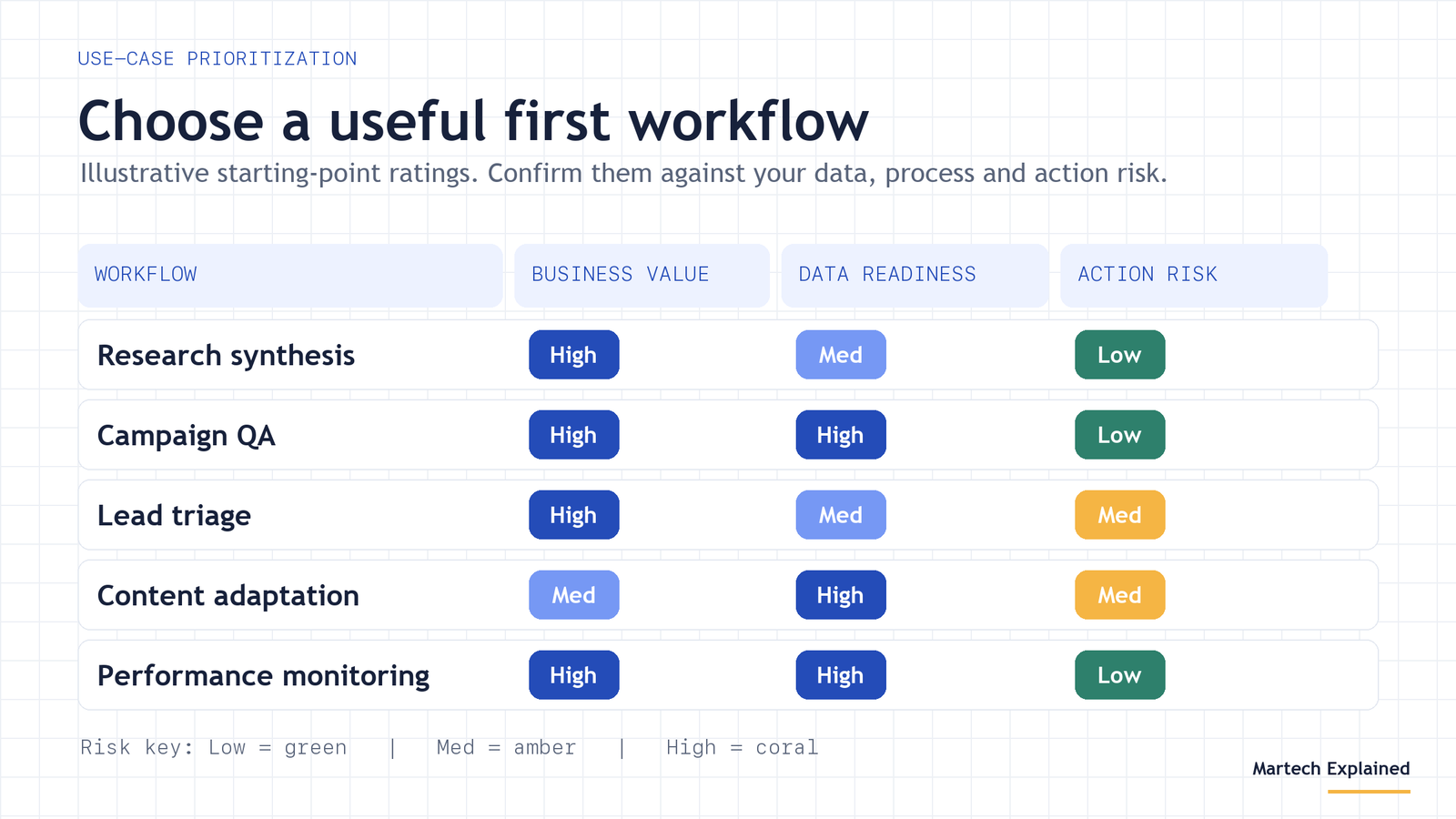
For a first pilot, campaign QA is often easier to bound than autonomous campaign creation. The agent can compare a draft against a checklist, while deterministic checks verify exact values such as URLs, UTM names, and required fields. A marketer reviews anything involving claims, targeting, spend, or publication.
Some teams prototype the reasoning step with ChatGPT or Claude and connect approved tools through an existing workflow platform such as n8n or Zapier. The product name does not determine the autonomy level. The important parts are the goal, available data, permitted actions, and approval rules.
From the field
[Ashwin: add one real AI experiment you ran. What did the system do, what worked, and which action did you keep behind human approval? Replace this prompt with your experience or delete the box.]
Where AI agents fail
Agents fail when a team gives them a broad goal but no reliable way to tell whether they achieved it. “Improve pipeline” does not say which audience to focus on, what counts as a qualified lead, or which actions are allowed. A useful agent needs a narrow task and a measurable result.
They also fail when the context is incomplete. A campaign agent cannot make a sound recommendation if it sees only clicks but not conversions, consent status, campaign dates, or changes to tracking. If the data is stale or contradictory, the agent may sound confident while acting on the wrong picture.
Tool access creates another failure path. A system that can edit audiences, send emails, and change budgets has a wider blast radius than one that can read reports and prepare recommendations. External content can also contain instructions that try to manipulate an agent connected to tools. Limit access to what the task needs and treat untrusted inputs as data to evaluate, not commands to follow.
Long-running tasks can repeat actions, choose a poor route, or spend more than expected. Every run needs a maximum number of steps, a cost limit, and a clear condition for stopping or escalating.
Finally, an agent can appear successful in a demo and still fail at the business outcome. A polished explanation is not proof that the correct audience was selected or that a campaign change improved results. Test the outcome in the system and review the action trail.
Vendor labels need the same scrutiny. Gartner has warned that some companies call existing assistants, chatbots, or robotic process automation “agents” without adding meaningful agentic capability. Ask the vendor to show which decisions the software makes, which actions it can take, what data it uses, and where a human can intervene.
Guardrails: data, approvals, and budgets
Guardrails define what an agent may see, decide, and change. Set them before connecting the system to production tools. NIST’s AI Agent Standards Initiative identifies security, identity, and interoperability as important foundations for trusted agent use. Microsoft’s agent approval documentation shows one practical pattern: AI can handle decisions with defined criteria while a person reviews critical or exceptional cases.
Use these controls for a marketing agent:
- Limit permissions. Start with read-only access. Allow only the data and tools needed for the task. Separate the ability to recommend a change from the ability to make it.
- Set approval gates. Require a person to approve customer-facing messages, audience changes, spend changes, publication, and actions involving sensitive data.
- Keep hard rules deterministic. Enforce consent, suppression lists, spend caps, frequency limits, and data-retention rules in code or platform controls.
- Set stop conditions. Limit steps, runtime, API calls, and total cost. Stop if required fields are missing, sources disagree, or the agent cannot complete the task within its permissions.
- Keep an audit trail. Record the task, data sources, tool calls, decisions, approvals, final outcome, and cost. Make it possible to reconstruct what happened.
- Test before expanding access. Use historical examples and edge cases first. Add live traffic only after the agent meets a defined quality bar.
Evaluation needs to cover the complete task, not just the final response. Agents may call tools, change system state, and adapt over several turns. Anthropic’s guidance on agent evaluations recommends testing defined tasks and outcomes, then combining automated checks with monitoring and human review. For a marketing agent, that can mean checking whether the right campaign was flagged, the data is accurate, and no prohibited action occurred.
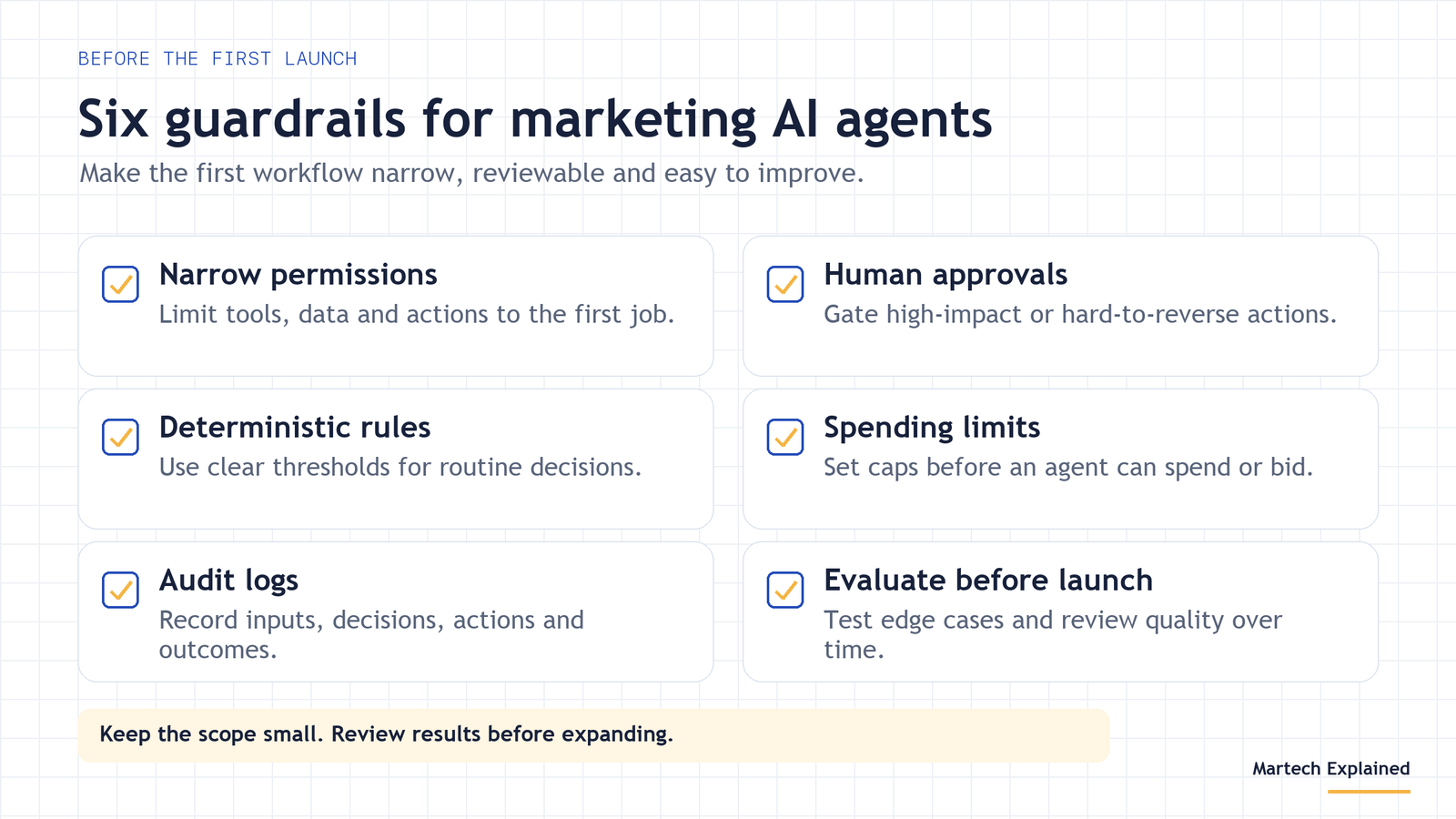
Use a human approval step while the team learns how the agent behaves. Remove that step only for a specific low-risk action after repeated tests show that the system follows its rules. Keep a way to pause the agent and reverse changes.
Start with one agent in 30 days
A small pilot can tell you whether an agent saves time or improves quality. Keep the first month focused on one task. Avoid building a multi-agent system before you know the workflow is worth changing.
- Days 1–3: Pick one measurable task. Choose a job that happens often, has a clear owner, and has a result you can check. Record the current time, quality, and cost. Good candidates include preparing a campaign QA report or summarizing weekly performance anomalies.
- Days 4–7: Set the boundary. Write down the input data, allowed tools, prohibited actions, approval points, step limit, and cost limit. Decide what the agent should do when data is missing or uncertain.
- Days 8–14: Test on past work. Run the agent on historical examples. Include normal cases, edge cases, missing data, conflicting records, and attempts to trigger an out-of-scope action. Compare the result with a human-reviewed answer.
- Days 15–21: Run a supervised pilot. Let the agent prepare work for a small group. Keep its connections read-only where possible. Require approval before it changes a customer record, sends a message, or changes campaign settings.
- Days 22–30: Measure and decide. Compare the pilot with the baseline. Review errors, time saved, cost per completed task, and how often a person had to correct the result. Stop, revise, or expand one permission at a time.
Do not measure success by the number of agents deployed. Measure the task: did it become faster, more accurate, or easier to manage without creating extra review work or risk?
Frequently asked questions
What is agentic marketing in simple terms?
It is marketing work where an AI agent can pursue a defined goal by choosing among approved steps and using connected tools. People set the goal, data access, and limits.
How is agentic marketing different from marketing automation?
Marketing automation follows conditions and actions that people define in advance. An agent can choose a next step based on the task and what it finds. A team can combine both: use an agent to interpret information and deterministic automation to enforce fixed rules.
Does agentic marketing mean fully autonomous campaigns?
No. Teams can use agents that only recommend actions, wait for approval, or execute low-risk tasks within limits. Full autonomy is a choice about permissions, not a requirement for using AI agents.
Do I need multiple AI agents for marketing?
Usually, start with one. Multiple agents can help when a task divides into clear specialist roles, but each handoff adds coordination and testing work.
How should a marketing team start with AI agents?
Choose one frequent task with a measurable result, test it on past examples, and start with narrow permissions and human review. Expand only when the tests show that the agent is reliable enough for the next action.
The bottom line
Agentic marketing gives AI systems room to choose and carry out steps toward a defined goal. The useful starting point is small: one task, clear data, limited permissions, measurable results, and a person who can stop or review the work. Increase autonomy only when the evidence supports it.
Get the next guide in your inbox
One email a week. Zero jargon. Get the new guides, one useful tool, and one number that matters.
Sources
- OpenAI, A Practical Guide to Building AI Agents.
- Anthropic, Building Effective AI Agents. The article notes that parts of its tooling landscape have changed since publication; used here for its workflow-versus-agent distinction.
- Scott Brinker and Frans Riemersma, “Buyer-side agents are the real disruption”, 2025. Survey sample and sponsorship context are described by the authors.
- Adobe, 2026 AI and Digital Trends report.
- Gartner, “Gartner Predicts Over 40% of Agentic AI Projects Will Be Canceled by End of 2027”, June 25, 2025.
- NIST, AI Agent Standards Initiative, February 17, 2026.
- Microsoft Learn, FAQ for AI Approvals in Copilot Studio.
- Anthropic, Demystifying Evals for AI Agents, January 9, 2026.