This martech glossary defines the 40 marketing technology terms marketers hear most, from A/B testing to zero-party data. Each entry gives a plain-English definition and one real-world example. Jump to a letter below, or use the acronym cheat sheet at the end for quick lookups.
If you’re new to the topic, start with what martech is and how it fits together, then come back here whenever a term stops you.
This glossary in 30 seconds
- 40 terms, each with a definition and a real example, plus 25 acronyms decoded.
- GA4 "conversions" are now called "key events". Google keeps the word "conversion" for Google Ads (Google, 2024).
- Chrome is keeping third-party cookies. Google retired its Privacy Sandbox replacement in October 2025.
- Looker Studio has been called Data Studio again since April 2026.
- GEO, getting cited in AI answers, comes from a 2023 research paper that measured visibility gains of up to 40%.
Table of Contents
How to use this glossary
Terms are in alphabetical order and grouped into four sections. Each one has a definition you could repeat to a colleague and an example from real marketing work. Acronyms are spelled out on first use, and the cheat sheet at the end lists 25 of them on one screen.
From the field
Attribution comes up in every budget meeting. I explain it with a football analogy: last-touch gives all the credit to the player who scored, and first-touch gives it to the one who started the move. Neither is wrong. They answer different questions, so pick one, write it down, and stop switching models when the numbers look bad.
A to C
A/B testing
A/B testing shows two versions of a page, email or ad to similar groups of people at random, then measures which one performs better on a single metric. You need enough traffic for the result to mean anything, which is what an A/B test sample size calculator works out.
Example: Half your list gets a subject line with the reader’s first name and half gets one without, and you compare click rates.
AI agent
An AI agent is software that uses a large language model to pursue a goal by planning steps, using tools and checking its own results. Marketing automation follows the rules you wrote; an agent decides the steps itself. Read the agentic marketing guide.
Example: An agent reads last week’s campaign data, finds the worst-performing ad set and drafts three new headlines for you to approve.
API
An application programming interface (API) is a set of rules that lets one piece of software ask another for data or tell it to do something. Most integrations between martech tools are built on APIs.
Example: Your website form uses the HubSpot API to create a contact the moment someone clicks Submit.
Attribution
Attribution decides how much credit each marketing touchpoint gets for a conversion. First-touch gives all the credit to the first visit, last-touch gives it to the last one, and multi-touch models split it.
Example: A buyer finds you through a LinkedIn ad, comes back through Google search and converts from an email. Last-touch credits the email; first-touch credits LinkedIn.
CAC (customer acquisition cost)
Customer acquisition cost (CAC) is what you spend on sales and marketing to win one new customer: total acquisition spend divided by new customers in the same period. The CAC and payback calculator works it out with payback months.
Example: $12,000 on ads, tools and salaries in a month that brought in 40 customers gives a CAC of $300.
CDP (customer data platform)
A customer data platform (CDP) collects customer data from many sources, merges it into one profile per person and sends audiences to other tools. Segment, for example, receives events from your site and app once and forwards them to every connected tool (Segment docs).
Example: A CDP combines a person’s website visits, app sessions and purchases, then sends a “bought twice, inactive for 30 days” audience to your email tool.
Churn rate
Churn rate is the share of customers who stop paying or using your product in a period: customers lost divided by customers at the start of the period.
Example: You start the month with 500 subscribers and lose 15, so monthly churn is 3%.
Consent Mode
Google Consent Mode adjusts how Google tags behave based on each visitor’s cookie choice. Version 2 added the ad_user_data and ad_personalization signals to the original ad_storage and analytics_storage (Google for Developers).
Example: A visitor rejects cookies on your banner. In advanced mode, GA4 still sends cookieless pings that Google uses to model the conversions you can’t see.
Conversion rate
Conversion rate is the share of visitors or recipients who complete the action you want: conversions divided by visitors, times 100.
Example: 2,000 landing page visitors and 60 demo requests is a 3% conversion rate.
Cookie
A cookie is a small text file a website stores in your browser. First-party cookies are set by the site you’re on; third-party cookies are set by other domains, usually for ads. Safari and Firefox restrict third-party cookies by default, but Google decided to keep them in Chrome and retired its Privacy Sandbox replacement in October 2025 (Engadget).
Example: GA4’s _ga cookie is first-party: it sits on your own domain and recognizes returning visitors.
CRM
A customer relationship management (CRM) system stores one record per contact and company, with every email, call, meeting and deal attached. It’s the source of truth for who your customers are.
Example: HubSpot shows that a lead opened three emails, booked a demo and is now a $20,000 deal in negotiation.
D to K
Data warehouse
A data warehouse is a database built for analysis. It stores large amounts of data from many tools in one place, and you query it with SQL. BigQuery, Snowflake and Amazon Redshift are the common ones.
Example: You join GA4’s event export with CRM revenue in BigQuery to see revenue by first-touch channel.
DMP (data management platform)
A data management platform (DMP) builds anonymous audience segments for buying ads. DMPs rely on third-party cookies to build and reach those segments (Forrester), so they weaken as browsers block those cookies.
Example: An advertiser buys a “frequent business travelers” segment to target display ads on news sites.
Event
An event is a single action your analytics tool records, such as a page view, click, video play or purchase. GA4 records everything as an event, with parameters that add detail.
Example: A purchase event with the parameters value=49 and currency=USD.
First-party data
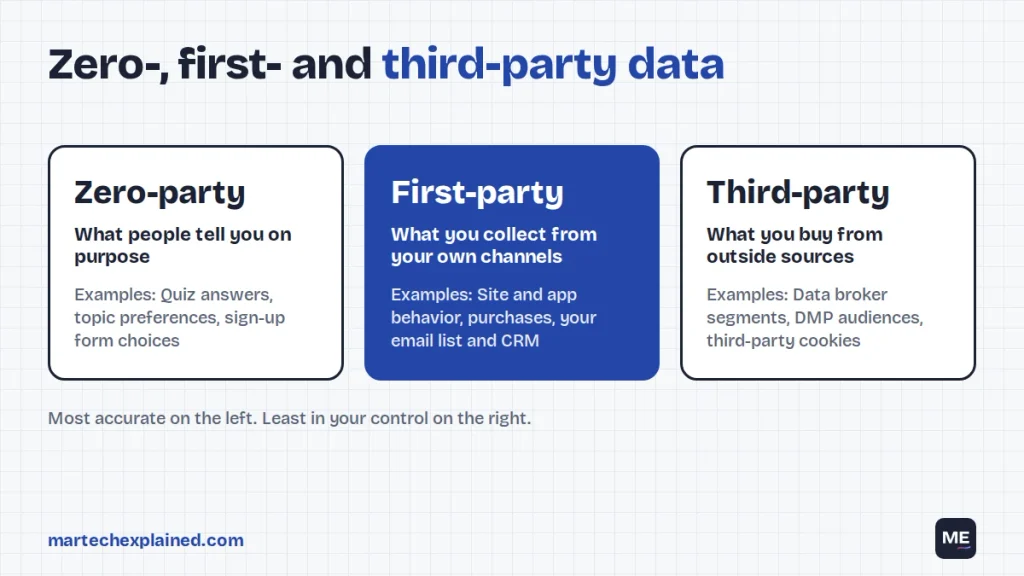
First-party data is information you collect directly from your own audience on your own site, app and channels: behavior, purchases and contact details. Zero-party data is what people tell you on purpose, and third-party data is bought from outside sources.
Example: Your email list, your CRM records and your GA4 data are all first-party data.
GA4 (Google Analytics 4)
Google Analytics 4 (GA4) is Google’s free web and app analytics tool. It’s built around events instead of sessions, and it replaced Universal Analytics, which stopped processing data in July 2023.
Example: You check which landing pages led to the most sign_up key events last month.
GEO (generative engine optimization)
Generative engine optimization (GEO) is the work of getting your content cited in AI answers from ChatGPT, Perplexity, Gemini and Google’s AI Overviews. The term comes from a 2023 research paper that found some content changes raised visibility in AI answers by up to 40% (Aggarwal et al.). It’s also called answer engine optimization (AEO).
Example: You rewrite a pricing page so the first sentence under each heading answers the question directly, with a sourced number.
Google Tag Manager
Google Tag Manager (GTM) is a free tool that loads tracking code, called tags, on your site from one container. You can add or change tracking without a developer release.
Example: You add the LinkedIn Insight Tag to every page and a GA4 event to the demo form in one afternoon.
Headless CMS
A headless content management system (CMS) stores content and serves it through an API to any front end, such as a website, an app or an in-store screen. A traditional CMS like WordPress stores the content and also builds the pages.
Example: Contentful feeds the same product descriptions to a website and a mobile app.
Identity resolution
Identity resolution matches records from different devices and tools to the same person, using identifiers like an email address, login ID or phone number. It’s what lets a CDP build one profile per customer.
Example: An anonymous mobile visit is linked to a known contact after the visitor logs in with the same email.
iPaaS
An integration platform as a service (iPaaS) moves data between apps when something happens, without custom code. Zapier, Make and n8n are the ones marketing teams use most.
Example: Every new form response creates a HubSpot contact and posts a message in Slack.
Key event
A key event is a GA4 event you’ve marked as important to your business, such as a sign-up or purchase. GA4 renamed conversions to key events in 2024, and “conversion” now refers to actions used in Google Ads (Google Analytics Help).
Example: You mark generate_lead as a key event so it appears in GA4 reports and can be imported into Google Ads as a conversion.
L to P
Lead scoring
Lead scoring gives each lead points for who they are, such as job title and company size, and what they do, such as pricing page visits and email clicks. Sales then calls the highest-scoring leads first.
Example: +20 for a pricing page view, +15 for a director title and −10 for a personal Gmail address, with 60 points making an MQL.
Lifecycle marketing
Lifecycle marketing sends people different messages depending on their stage with you: new subscriber, trial user, first-time buyer, loyal customer or at risk of leaving.
Example: A trial user who hasn’t connected their data by day 3 gets a setup guide, and a customer who hasn’t logged in for 30 days gets a win-back email.
LTV (customer lifetime value)
Customer lifetime value (LTV or CLV) is the total gross profit you expect from a customer over the whole relationship. A simple version is average monthly gross profit per customer divided by monthly churn rate.
Example: $60 gross profit a month and 3% monthly churn gives an LTV of $2,000 ($60 ÷ 0.03).
Marketing automation
Marketing automation is software that sends messages and updates records automatically when someone meets a rule you set, such as filling in a form or reaching a date. Read what marketing automation is.
Example: Someone downloads an ebook, gets four nurture emails over two weeks, and is passed to sales if they click the pricing link.
Martech stack
A martech stack is the set of marketing tools a company uses, connected so data flows between them. Most stacks have six layers: collection, storage, CRM, engagement, content and analytics. Read the martech stack explained for each layer.
Example: Google Tag Manager, BigQuery, HubSpot, Brevo, WordPress and GA4 together make a typical small B2B stack.
MCP (Model Context Protocol)
The Model Context Protocol (MCP) is an open standard that Anthropic introduced in November 2024 (Anthropic). It lets AI assistants connect to tools and data through one common interface, instead of a custom integration for each tool.
Example: You connect an AI assistant to your analytics and CRM through MCP servers, then ask which campaign drove the most demos last week.
MQL (marketing qualified lead)
A marketing qualified lead (MQL) is a lead that marketing judges ready for sales, usually because it passed a lead score threshold or took a high-intent action. Once sales qualifies it, it becomes a sales qualified lead (SQL).
Example: A visitor who requests a demo becomes an MQL straight away, while one who downloads ebooks reaches the threshold over time.
Personalization
Personalization changes what a person sees on your site, in email or in your app, based on what you know about them: location, industry, behavior or lifecycle stage.
Example: Visitors from healthcare companies see healthcare customer logos and a healthcare case study on the homepage.
Pixel
A pixel is a small piece of tracking code that an ad platform asks you to add to your site, so it can record visits and conversions from its ads. The name comes from the original version, a 1×1 invisible image.
Example: The Meta Pixel fires a Purchase event so Meta can show your ads to people likely to buy.
R to Z
Retargeting
Retargeting shows ads to people who already visited your site or app, using a pixel or a list of your contacts. It’s also called remarketing.
Example: Everyone who viewed your pricing page in the last 30 days sees a LinkedIn ad with a customer story.
Reverse ETL
Reverse ETL copies cleaned, modeled data from your data warehouse back into the tools teams use every day, like the CRM, ad platforms and email tool. ETL (extract, transform, load) moves data into the warehouse; reverse ETL moves it out.
Example: A product-qualified-lead flag calculated in BigQuery syncs to Salesforce every hour.
ROAS (return on ad spend)
Return on ad spend (ROAS) is revenue from ads divided by what you spent on them. It ignores costs beyond media, so a positive ROAS doesn’t always mean profit.
Example: $5,000 in ad spend that drove $20,000 in revenue is a ROAS of 4, often written 4:1 or 400%.
Segmentation
Segmentation splits your audience into groups that share traits or behavior, so each group gets a more relevant message.
Example: Customers who bought in the last 90 days, customers who haven’t bought in a year, and subscribers who’ve never bought each get a different email.
Server-side tagging
Server-side tagging sends tracking data from the browser to a server you control first. You then decide what each vendor receives, instead of loading every vendor’s tag in the visitor’s browser (Google Tag Manager docs).
Example: A server-side GTM container removes IP addresses before forwarding events to GA4 and Meta.
SQL (sales qualified lead)
A sales qualified lead (SQL) is a lead a salesperson has spoken to and confirmed has a real need, budget and timeline. Don’t confuse it with SQL, the query language used in data warehouses.
Example: After a discovery call, an MQL with a confirmed budget and a 3-month timeline becomes an SQL.
UTM parameters
UTM parameters are tags added to the end of a link that tell analytics tools where a visit came from. Google recommends always setting utm_source, utm_medium and utm_campaign (Google Analytics Help). The free UTM builder creates them for you.
Example: martechexplained.com/?utm_source=linkedin&utm_medium=social&utm_campaign=q4-webinar
Webhook
A webhook is a message one app sends to another automatically when something happens, so the receiving app doesn’t have to keep checking. Many real-time workflows start with a webhook.
Example: Stripe sends a webhook to your CRM the moment a payment succeeds, and the deal moves to Closed won.
Zero-party data
Zero-party data is information a customer gives you on purpose, such as preferences, goals or quiz answers. It’s accurate because nobody had to guess it from behavior.
Example: A sign-up form asks which topics a subscriber wants, and the newsletter only sends those.
Martech acronym cheat sheet
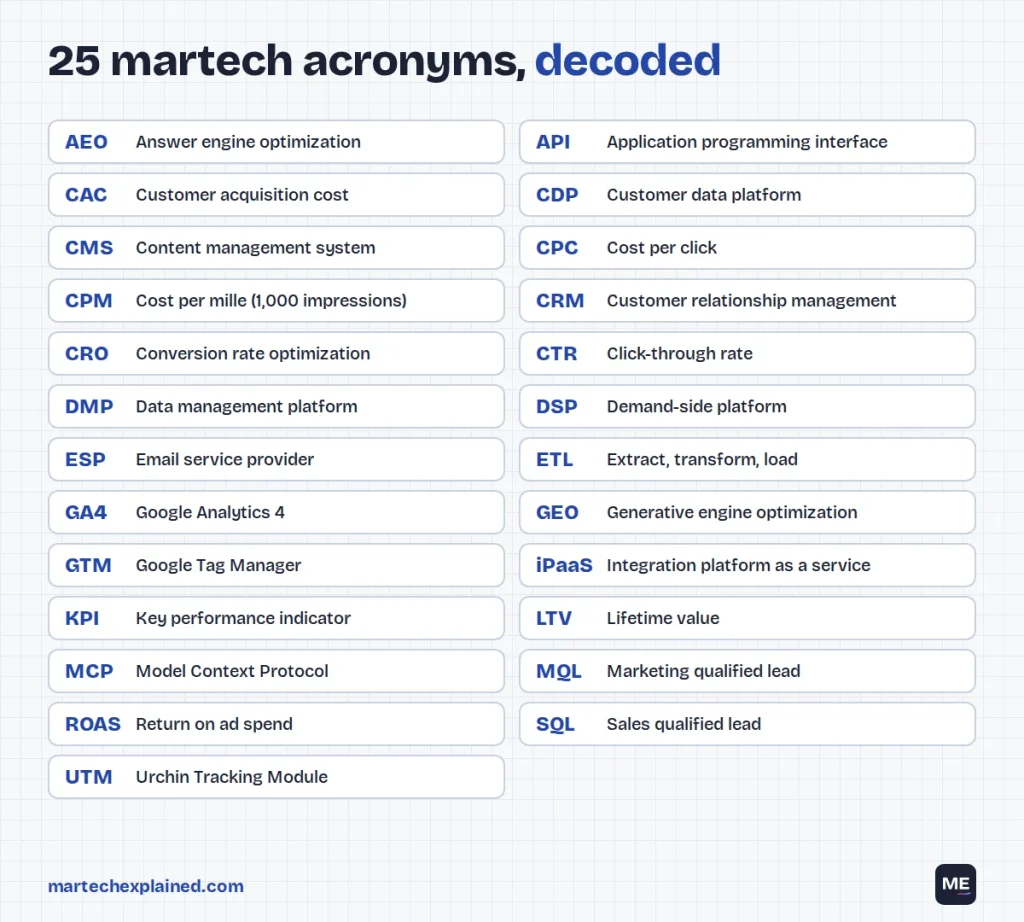
The 25 acronyms you’ll meet most, on one screen:
| Acronym | Stands for | In one line |
|---|---|---|
| AEO | Answer engine optimization | Getting cited in AI answers; another name for GEO |
| API | Application programming interface | How software talks to other software |
| CAC | Customer acquisition cost | Spend to win one customer |
| CDP | Customer data platform | One profile per customer, sent to other tools |
| CMS | Content management system | Where your website content lives |
| CPC | Cost per click | Ad spend divided by clicks |
| CPM | Cost per mille | Cost of 1,000 ad impressions |
| CRM | Customer relationship management | One record per contact, company and deal |
| CRO | Conversion rate optimization | Testing changes to raise conversion rate |
| CTR | Click-through rate | Clicks divided by impressions |
| DMP | Data management platform | Anonymous ad audiences from third-party cookies |
| DSP | Demand-side platform | Software for buying display and video ads |
| ESP | Email service provider | The tool that sends your email |
| ETL | Extract, transform, load | Moving data into a warehouse |
| GA4 | Google Analytics 4 | Google’s free event-based analytics |
| GEO | Generative engine optimization | Getting cited in ChatGPT, Perplexity and AI Overviews |
| GTM | Google Tag Manager | Loads tracking tags from one container |
| iPaaS | Integration platform as a service | Connects apps without code |
| KPI | Key performance indicator | The number that shows if you’re on track |
| LTV | Lifetime value | Profit from a customer over the relationship |
| MCP | Model Context Protocol | Standard for connecting AI assistants to tools |
| MQL | Marketing qualified lead | A lead marketing thinks is ready for sales |
| ROAS | Return on ad spend | Ad revenue divided by ad spend |
| SQL | Sales qualified lead, or Structured Query Language | A lead sales has qualified, or the language for querying data |
| UTM | Urchin Tracking Module | Link tags that record where a visit came from |
Frequently asked questions
What does martech stand for?
Martech is short for marketing technology: the software marketing teams use to reach customers, understand them and measure results.
What is the difference between a CDP and a CRM?
A CRM stores the records your sales and marketing teams work with every day, such as contacts, companies and deals. A CDP collects behavior data from many sources, such as your website and app, merges it into profiles and sends audiences to other tools.
Which martech terms should a new marketer learn first?
Start with the ones you’ll see in reports every week: conversion rate, CAC, key event, UTM parameters, attribution and MQL. Then learn the tools behind them: CRM, GA4 and Google Tag Manager.
The bottom line
Martech jargon changes fast, but most of it describes a handful of jobs: collecting data, connecting it, acting on it and measuring the result. Bookmark this page, and use the acronym table when a meeting moves faster than you can search.
Next in this series: What Is Marketing Automation? How It Works, With Examples.
Get the next guide in your inbox
One email a week: the new guides, one tool worth knowing and one number that matters.
Sources
- About key events, Google Analytics Help
- Consent mode overview, Google for Developers
- URL builders: collect campaign data with custom URLs, Google Analytics Help
- Introduction to server-side tagging, Google for Developers
- Data Studio release notes, Google Cloud, April 2026
- GEO: Generative Engine Optimization, Aggarwal et al., KDD 2024 (first published November 2023)
- Introducing the Model Context Protocol, Anthropic, November 2024
- Google has killed Privacy Sandbox, Engadget, October 2025
- Oracle exits the advertising business, Forrester
- Connections overview, Segment documentation, Twilio