Generative engine optimization (GEO) is the work of getting your content cited in AI-generated answers, such as Google’s AI Overviews and AI Mode, ChatGPT search and Perplexity. It builds on SEO rather than replacing it. AI answers pull from pages that are already crawlable, indexed and trusted, then pick the sources that answer the question most clearly.
The stakes are rising. Google says AI Mode passed 1 billion monthly active users after its global expansion (Google, July 2026). And when an AI summary appears, people click a normal search result on 8% of visits, against 15% when there’s no summary (Pew Research Center, July 2025).
This guide separates what Google, OpenAI and Perplexity have said publicly from the myths, then shows how to measure AI visibility in Search Console and GA4. It’s part of the wider picture in what is martech.
Generative engine optimization in 30 seconds
- GEO means earning citations in AI answers. The term comes from a 2023 Princeton and IIT Delhi paper, published at KDD 2024.
- In that study, adding quotations, statistics and cited sources raised a page’s visibility in AI answers by up to 40%. Keyword stuffing did not help.
- Google says there are no extra requirements for AI Overviews or AI Mode: a page must be indexed and eligible for a snippet.
- llms.txt, content chunking and special schema are not needed for Google Search, per Google’s own guide.
- Measure it in Search Console’s generative AI performance report and in a GA4 channel group for AI referrals.
Table of Contents
What is generative engine optimization?
Generative engine optimization is the practice of making your content more likely to be quoted, summarized or linked in answers written by AI. A generative engine is any search tool that writes an answer instead of only listing links. The martech glossary has the one-line version.
The term comes from a research paper by Pranjal Aggarwal and colleagues at IIT Delhi and Princeton University. It was first posted in November 2023 and published at the KDD 2024 conference (Aggarwal et al., 2024). The authors built a benchmark of 10,000 queries and tested how different content changes affected a source’s visibility in AI answers.
In practice, GEO covers three jobs:
- Access: letting AI search crawlers read your pages.
- Selection: writing pages that answer questions clearly enough to be picked as a source.
- Measurement: tracking how often you appear and how many visits AI answers send.
How do AI answers choose their sources?
AI answers choose sources by running searches, reading the pages that come back and citing the ones that best support each part of the answer. Each engine does this with its own index and crawler, so the rules for getting in differ slightly.
- Google AI Overviews and AI Mode: both use Google’s search index. Both may use “query fan-out”, running several related searches across subtopics and then showing a wider set of links (Google Search Central). In July 2026 Google said it had brought the two together into one Search experience.
- ChatGPT search: uses OpenAI’s OAI-SearchBot crawler. OpenAI says any public website can appear, as long as it isn’t blocking that crawler (OpenAI Help Center).
- Perplexity: uses PerplexityBot to surface and link websites in its answers. Perplexity says this crawler isn’t used to train AI models (Perplexity docs).
- Claude: Anthropic uses Claude-SearchBot for search results and Claude-User when a person asks Claude to fetch a page. Its training crawler, ClaudeBot, is separate (Anthropic).
The pattern across all four: AI answers are built on search. A page that can’t be crawled or indexed can’t be cited, however well it’s written.
Some AI assistants also read your tools and data directly, through connectors rather than search. That’s a different channel, covered in the Model Context Protocol (MCP) guide.
GEO vs SEO vs AEO: what’s the difference?
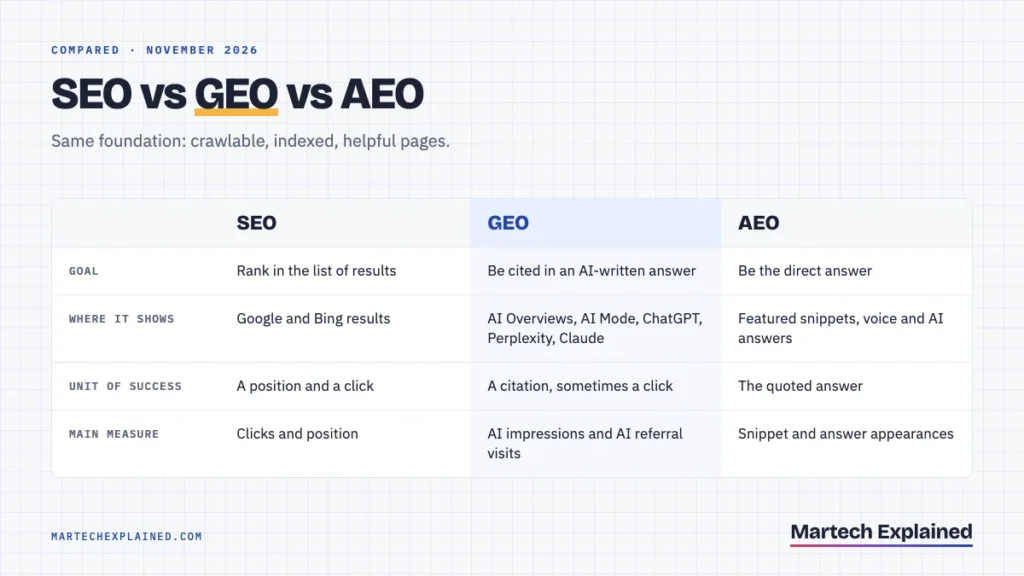
SEO earns rankings in search results, GEO earns citations inside AI-written answers, and answer engine optimization (AEO) earns the direct answer to a question, from featured snippets to AI answers. Many people now use GEO and AEO to mean the same thing. All three rest on the same foundation: crawlable, indexed, helpful pages.
| SEO | GEO | AEO | |
|---|---|---|---|
| Goal | Rank in the list of results | Be cited in an AI-written answer | Be the direct answer to a question |
| Where it shows | Google and Bing results pages | AI Overviews, AI Mode, ChatGPT, Perplexity, Claude | Featured snippets, voice answers, AI answers |
| Unit of success | A position and a click | A citation or mention, sometimes a click | The quoted answer |
| Main measure | Search Console clicks and position | AI impressions, citations and AI referral visits | Snippet and answer appearances |
| What it needs first | Crawlable, indexed, helpful pages | The same, plus clear, sourced answers | The same, plus a question-and-answer structure |
Google’s own advice backs this up. Its AI optimization guide says to prioritize foundational SEO over “AEO/GEO hacks” (Google Search Central, July 2026).
What earns citations in AI answers?
Citations go to pages that answer the question directly and back it with evidence: specific numbers, named sources and quotes from people who know the subject. That’s what the GEO research measured, and it matches what Google asks for.
The paper tested nine content changes. On its main visibility metric, where unedited pages scored 19.3, the strongest changes scored:
| Content change | Visibility score | vs no change (19.3) |
|---|---|---|
| Add quotations from relevant sources | 27.2 | About +41% |
| Add statistics | 25.2 | About +31% |
| Improve fluency | 24.7 | About +28% |
| Cite sources | 24.6 | About +27% |
| Keyword stuffing | 17.7 | About −8% |
Read those numbers with care. The study used a simulated AI engine built on GPT-3.5 and the top 5 Google results, not live ChatGPT or Google. It shows direction, not a guaranteed lift. The same paper reported gains of up to 37% when it tested on Perplexity.
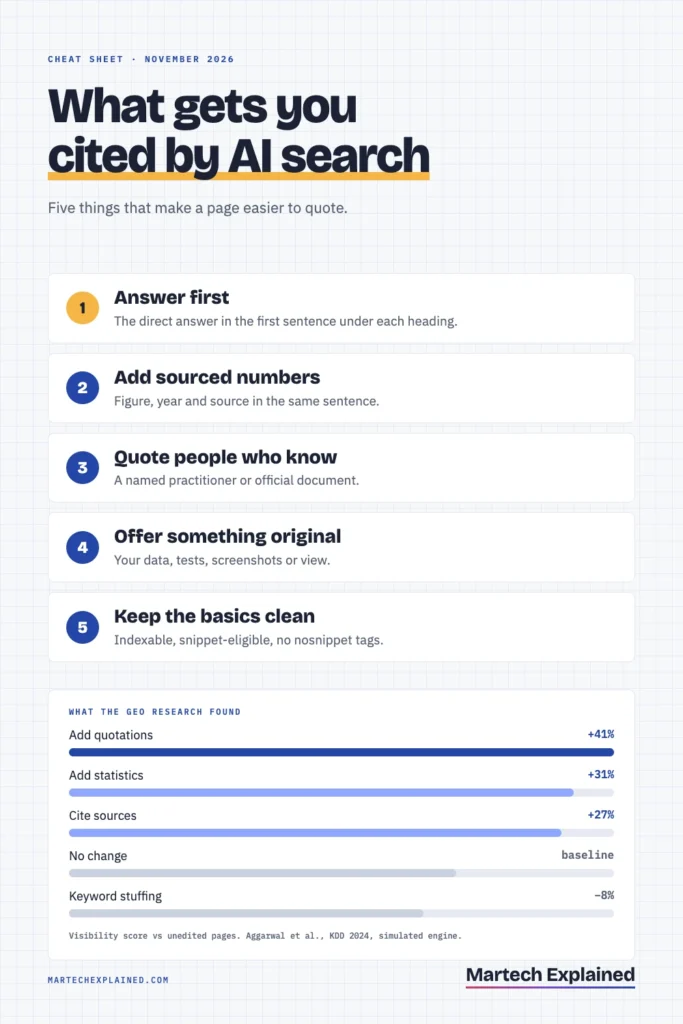
Put together with Google’s guidance, five things make a page easier to cite:
- Answer first. Put the direct answer in the first one or two sentences under each heading, and repeat the subject instead of writing “it”.
- Add sourced numbers. Give the figure, the year and the source in the same sentence, linked to the original.
- Quote people who know. A short quote from a named practitioner or official document gives the AI something specific to pull.
- Offer something original. Google calls this “non-commodity” content: your data, tests, screenshots or first-hand view.
- Keep the technical basics clean. The page must be indexable, eligible for a snippet and free of nosnippet or tight max-snippet tags.
Mentions on other sites count too. AI answers often cite reviews, community threads and trade press, not only your own pages. A real mention in a well-read newsletter or a helpful forum answer can do more than another page on your site.
Which GEO myths can you ignore?
Most GEO myths are shortcuts that Google has said it doesn’t use, or rules borrowed from one AI engine and applied to all of them. These six come up most often:
- “You need an llms.txt file.” Google says llms.txt files and other special markup aren’t used by Google Search (Google Search Central). Other engines haven’t committed to using it either.
- “Chop content into small chunks for AI.” Google says there’s no requirement to break content into tiny pieces, and no ideal page length. Write sections that make sense on their own, at whatever length the topic needs.
- “Add special AI schema.” Google says there’s no special schema.org markup needed for AI Overviews or AI Mode. Structured data still helps for rich results.
- “Blocking GPTBot keeps you out of ChatGPT.” GPTBot collects training data. ChatGPT search uses OAI-SearchBot, and OpenAI controls the two separately. Block GPTBot if you don’t want your content used for training, but keep OAI-SearchBot allowed.
- “Google-Extended controls AI Overviews.” Google describes Google-Extended as a control for AI training and grounding in other Google products. The control for Search, including its AI features, is Googlebot.
- “Repeat the keyword so AI picks you.” Keyword stuffing scored below unedited pages in the GEO study. Clear answers and evidence did better.
How do you measure AI visibility?
Measure AI visibility in two places: Google Search Console for how often you appear in Google’s AI features, and GA4 for the visits AI answers send you. Add a monthly prompt log for the engines that don’t report anything to you.
In Google Search Console
Search Console’s generative AI performance reports show how often your URLs appeared in AI Overviews, AI Mode and AI features in Discover. Google launched them in June 2026 and rolled them out to all sites by August 31, 2026 (Google Search Central Blog).
- What they show: impressions, which pages appeared, countries, devices and dates down to the hour.
- What they don’t: a separate click count. Clicks from AI features are counted in the normal Performance report under “Web”.
In GA4
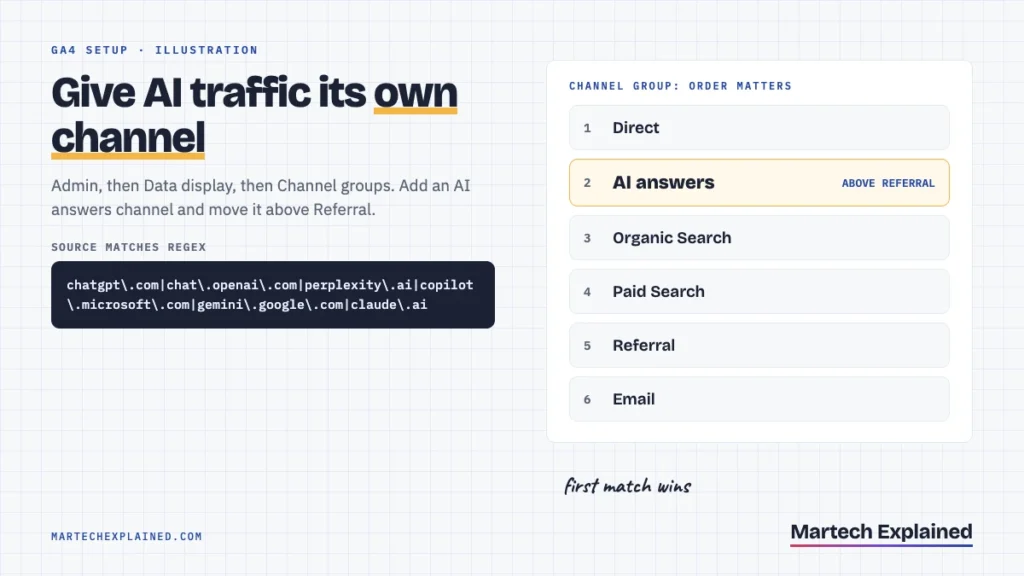
In GA4, create a custom channel group with an “AI answers” channel, so visits from ChatGPT, Perplexity, Copilot, Gemini and Claude stop hiding inside Referral. ChatGPT adds utm_source=chatgpt.com to its links, which makes it easy to spot.
- Open the channel groups. Go to Admin, then Data display, then Channel groups, and click Create new channel group. You need the Editor role.
- Add the channel. Name it “AI answers” and set the condition to Source, matches regex, with the pattern below.
- Move it above Referral. GA4 assigns each visit to the first channel it matches, so the AI channel must sit higher in the list (Google Analytics Help).
- Save and check. Custom channel groups apply to past data too, so open Traffic acquisition and switch the channel group to see results straight away.
chatgpt\.com|chat\.openai\.com|perplexity\.ai|copilot\.microsoft\.com|gemini\.google\.com|claude\.aiOne limit to know: clicks from Google’s AI Overviews and AI Mode arrive from Google itself, so GA4 counts them as ordinary Google organic traffic. Use Search Console for those, and GA4 for the other engines.
With a prompt log
Once a month, ask ChatGPT, Perplexity and Google AI Mode the 10 questions your best pages answer. Note whether you’re cited, who is cited instead and what those pages do differently. A shared spreadsheet is enough to start.
A 30-day GEO plan
A 30-day GEO plan fixes access first, then measurement, then the pages most likely to be cited. Here’s one week at a time:
- Week 1: check access. Confirm robots.txt allows Googlebot, Bingbot, OAI-SearchBot, PerplexityBot and Claude-SearchBot. Check your key pages for noindex, nosnippet and max-snippet tags.
- Week 2: set up measurement. Open the generative AI report in Search Console, build the AI answers channel in GA4, and record your first prompt log.
- Week 3: rewrite five pages. Pick pages that already rank in the top 20. Make each section answer first, add sourced numbers and one expert quote, and update the visible date.
- Week 4: earn one mention elsewhere. Answer a real question in a community where your page helps, or pitch one data point to a newsletter. Then rerun the prompt log and compare.
If you use AI agents in your own marketing work, the same rule applies to their research: they cite what they can find and trust. See what agentic marketing means for how agents fit into the rest of the stack.
Frequently asked questions
Is GEO replacing SEO?
No. GEO depends on SEO, because AI answers draw on pages that are already crawlable, indexed and trusted. Google’s own guide tells site owners to put foundational SEO ahead of GEO tactics. Think of GEO as SEO with a new place your content can show up.
Is GEO the same as AEO?
Mostly. Answer engine optimization (AEO) started with featured snippets and voice answers, while generative engine optimization (GEO) was named for AI-written answers. Today most marketers use the two terms for the same work: getting your content quoted as the answer.
How do I get my website into AI Overviews?
Google says there are no extra requirements for AI Overviews or AI Mode. Your page must be indexed and eligible to show with a snippet. From there, clear answers, sourced facts and original content give it the best chance of being picked.
Do I need llms.txt for GEO?
Not for Google. Google says llms.txt files aren’t used by Google Search. It does no harm to have one, but it won’t fix a page that AI engines can’t crawl or don’t find useful.
Can I track ChatGPT traffic in GA4?
Yes. ChatGPT adds utm_source=chatgpt.com to the links it sends, so the visits show under that source in GA4. A custom channel group called “AI answers” groups ChatGPT with Perplexity, Copilot, Gemini and Claude in one line of your reports.
How long does GEO take to work?
Expect weeks, not days. Pages have to be recrawled before changes show, and Google says recrawling can take from several days to several months. Track the same prompts monthly so you can see change over time.
The bottom line
Generative engine optimization is good SEO plus clear, sourced answers, measured in two new places. Let the AI search crawlers in and write each section so it can be quoted on its own. Then check Search Console’s AI report and a GA4 AI answers channel every month.
Next in this series: How to Get Your Brand Cited in ChatGPT, Perplexity and AI Overviews.
Get the next guide in your inbox
One email a week: the new guides, one tool worth knowing and one number that matters.
Sources
- GEO: Generative Engine Optimization, Aggarwal, Murahari, Rajpurohit, Kalyan, Narasimhan and Deshpande, KDD 2024 (first posted November 2023)
- Q2 2026 earnings call: remarks from our CEO, Google, July 2026
- Google users are less likely to click on links when an AI summary appears in the results, Pew Research Center, July 2025
- Google’s guide to optimizing for generative AI features on Google Search, Google Search Central, July 2026
- AI features and your website, Google Search Central, December 2025
- Introducing Search Generative AI performance reports in Search Console, Google Search Central Blog, June 2026
- Publishers and developers FAQ, OpenAI Help Center, checked November 2026
- Overview of OpenAI crawlers, OpenAI, checked November 2026
- Perplexity crawlers, Perplexity, checked November 2026
- How can I control which crawlers Anthropic uses on my website?, Anthropic, checked November 2026
- Custom channel groups, Google Analytics Help, checked November 2026