Martech is the software marketers use to plan, run and measure their work. It covers everything from the tool that sends your newsletter to the dashboard that tells you whether it made money.
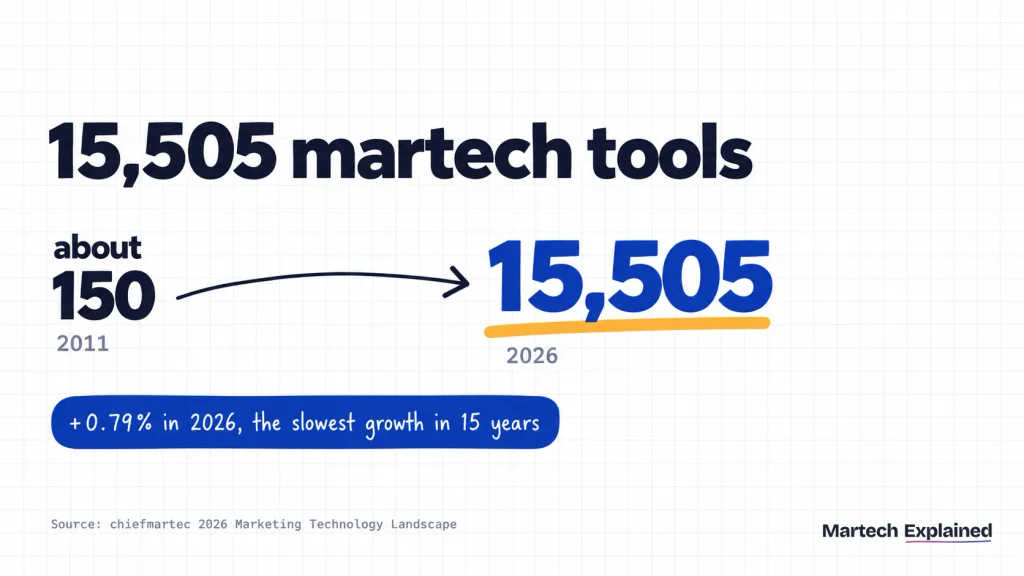
It is also one of the most crowded software markets in the world. The 2026 Marketing Technology Landscape counts 15,505 products, up from about 150 in 2011. This year, for the first time in 15 years, that number barely moved. Growth was 0.79%.
I’ve spent more than eight years buying, integrating and retiring these tools across B2B SaaS and consumer fintech. This guide is the explanation I wish I’d had on day one: what martech is, how the pieces fit together, what it costs, and how AI agents are changing it.
Martech in 30 seconds
- Martech = software for marketing work: customer data, content, channels, analytics and operations.
- 15,505 martech products exist in 2026. New launches fell 40% year over year while 1,367 products disappeared.
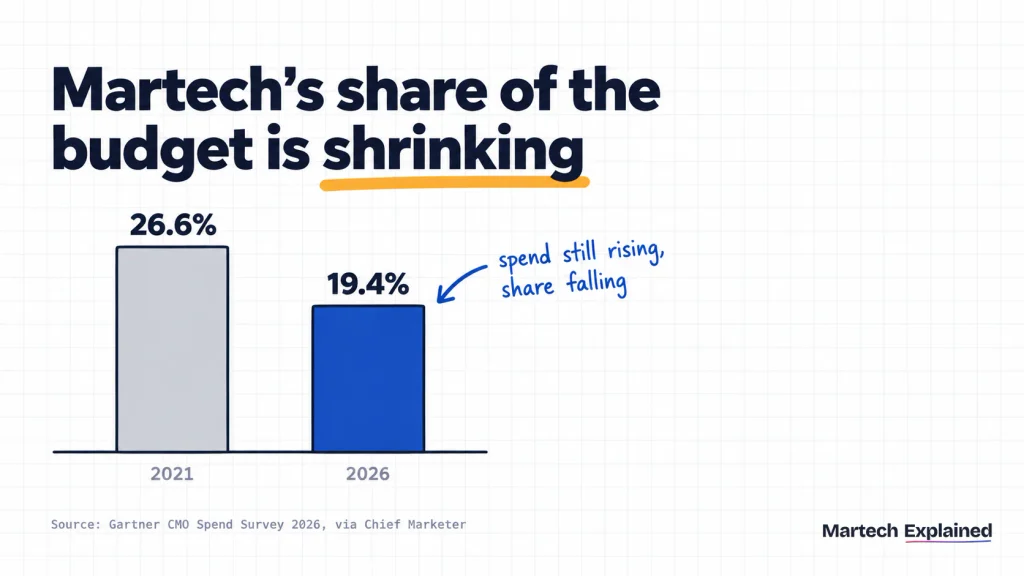
- Martech takes 19.4% of the average marketing budget, down from 26.6% in 2021 (Gartner).
- Teams use only about a third of what their stack can do (Gartner, 2023).
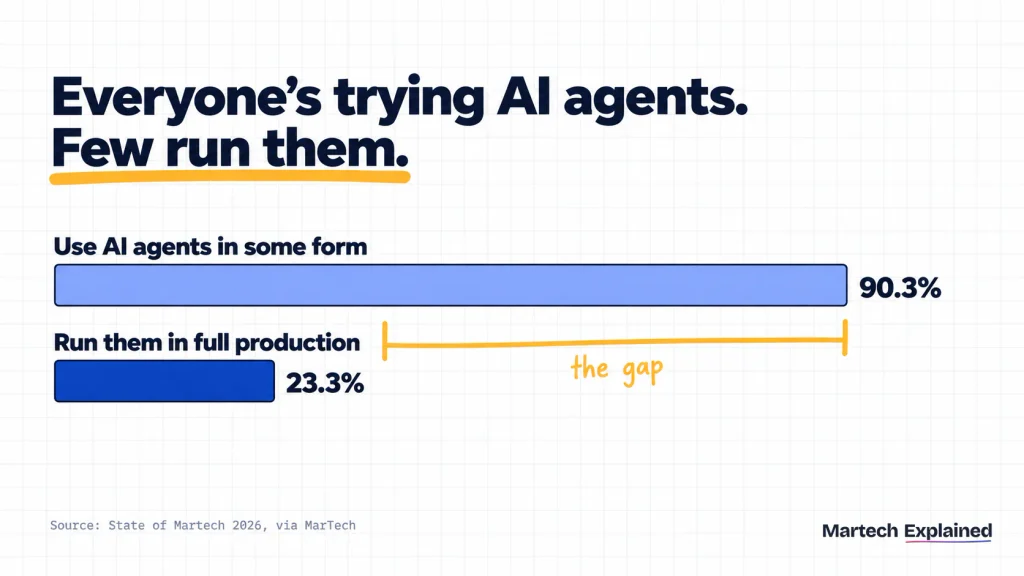
- 90.3% of marketing teams use AI agents in some form, but only 23.3% run them in full production (State of Martech 2026).
Table of Contents
What is martech?
Martech (short for marketing technology) is any software a marketing team uses to reach customers, understand them and prove what worked. If a tool touches your audience data, your content, your channels or your reporting, it’s martech.
The word went mainstream through Scott Brinker. He started the chiefmartec.com blog in 2008 and published the first Marketing Technology Landscape “supergraphic” in August 2011. That chart, updated almost every year since, is still the closest thing the industry has to a census. New to the jargon? Keep the martech glossary open in another tab.
What counts as martech
- Email and marketing automation: Mailchimp, Brevo, HubSpot Marketing Hub
- Web and product analytics: Google Analytics 4, Mixpanel, Amplitude
- Tag management and data collection: Google Tag Manager, Segment
- Websites and content: WordPress, Webflow, Contentful
- SEO: Ahrefs, Semrush
- Testing and personalization: VWO, Optimizely
- Social media management: Buffer, Hootsuite, Sprout Social
- Customer data platforms (CDPs) and CRMs: the systems that hold who your customers are
What usually doesn’t
- General productivity tools like Google Docs or Slack. They help marketers, but they aren’t built for marketing.
- Ad buying infrastructure like demand-side platforms and ad exchanges. That’s adtech, covered below.
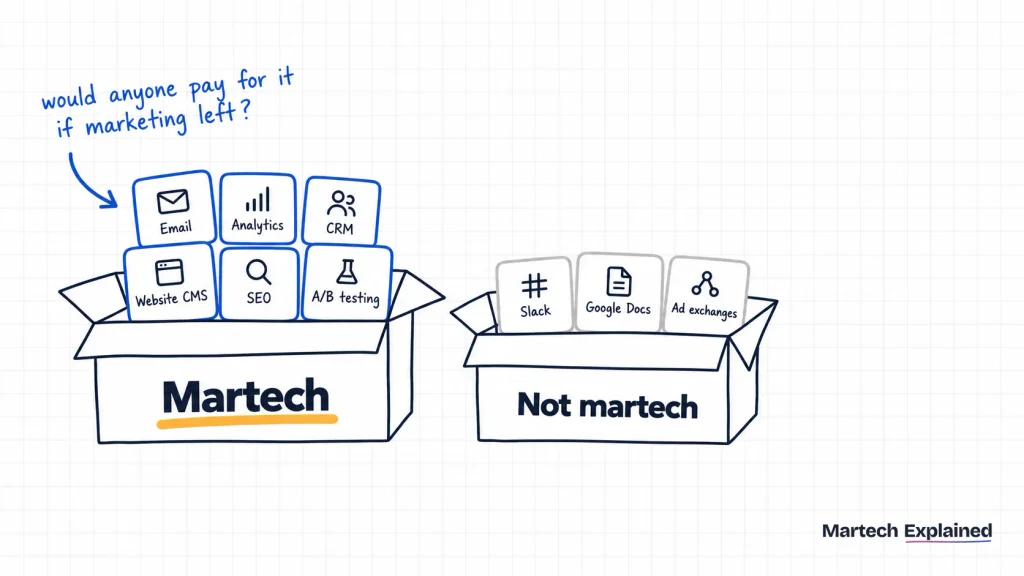
A quick test I use: if the marketing team disappeared tomorrow, would anyone still pay for this tool? If not, it’s martech.
From the field
At Freo in 2021, when I was a marketing manager, MoEngage was in our stack, but not everyone was using it. I built an engagement charter for the product around the tool, setting out how we’d use it to engage customers.
Martech by the numbers (2026)
Martech is a market of about $150 billion a year that has stopped getting bigger by product count but keeps getting bigger by spend. Here are the numbers worth knowing, all from primary sources.
| What | Figure | Source |
|---|---|---|
| Martech products on the market | 15,505 in 2026, up 0.79% from 15,384 in 2025 | chiefmartec 2026 landscape |
| Growth since the first landscape | About 100x, from roughly 150 products in 2011 | chiefmartec 2025 landscape |
| Products added vs removed in 2026 | 1,488 added (down 40%), 1,367 removed (up 13%) | chiefmartec 2026 landscape |
| Global martech spend | $148 billion in 2024, forecast to pass $215 billion by 2027 (13.3% a year) | Forrester |
| Marketing budget as a share of company revenue | 7.8% in 2026 (7.7% in 2025) | Gartner CMO Spend Survey 2026 |
| Martech’s share of the marketing budget | 19.4% in 2026, down from 26.6% in 2021 | Chief Marketer on Gartner 2026 |
| CMOs planning to invest more in martech anyway | 62% | Chief Marketer on Gartner 2026 |
| Share of marketing budget going to AI | 15.3% on average, 21.3% at AI-mature companies | Gartner CMO Spend Survey 2026 |
| Stack capabilities actually used | 33% in 2023, down from 42% in 2022 and 58% in 2020 | MarTech on Gartner 2023 |
Two things stand out. First, the budget share is falling while spend keeps rising, because marketing budgets are flat and paid media is taking a bigger slice (31.4% in 2026, a five-year high). Second, 56% of CMOs have moved more of their martech budget to usage-based pricing. That matters because AI features are often billed per credit, per contact or per run, so your bill can grow even when your seat count doesn’t.
The utilization number is the one I’d tape to every marketer’s monitor. Most teams don’t have a tooling gap. They have an adoption gap.
The 6 categories of martech
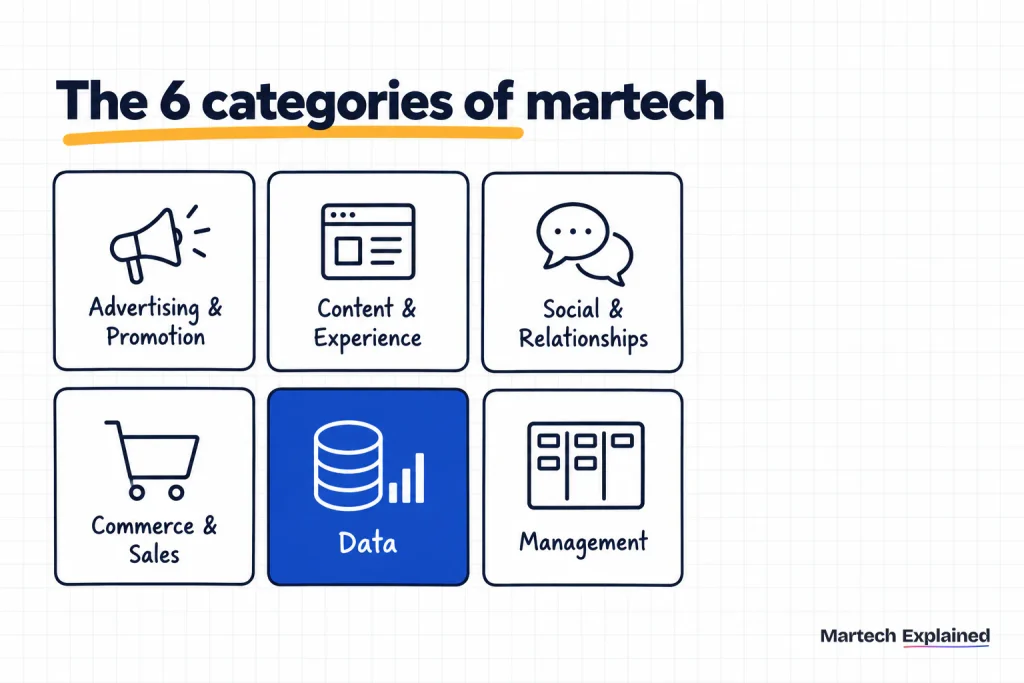
The industry sorts martech into six groups, the same six the chiefmartec landscape has used since 2016. Almost every tool you’ll ever evaluate fits into one of them.
| Category | What it does | Typical tool types | Well-known examples |
|---|---|---|---|
| Advertising & Promotion | Gets your message in front of new people | Search and social ads, display, video, native, PR | Google Ads, Meta Ads Manager, LinkedIn Campaign Manager |
| Content & Experience | Creates and delivers what people see and read | CMS, email, marketing automation, personalization, SEO, A/B testing | WordPress, Webflow, Mailchimp, HubSpot, Semrush, VWO |
| Social & Relationships | Manages conversations and communities | Social media management, CRM, reviews, influencer, community, live chat | Hootsuite, Sprout Social, Intercom |
| Commerce & Sales | Turns interest into revenue | Ecommerce platforms, sales automation, affiliate, channel and partner tools | Shopify, Salesforce, Outreach |
| Data | Collects, connects and makes sense of customer data | Analytics, CDPs, tag management, data enrichment, dashboards, iPaaS | GA4, Segment, Google Tag Manager, Looker Studio |
| Management | Runs the marketing team itself | Project management, budgeting, DAM, talent, agile tools | Asana, Monday.com, Bynder |
The fastest-growing corners of the 2026 landscape tell you where attention is going. CMS and web experience tools grew 21.4% (504 to 612 products), ecommerce platforms 19.9%, and mobile and web analytics 11.3%. Brinker’s read: AI is not only creating new categories, it is “reactivating old ones” (chiefmartec 2026).
Martech vs adtech vs salestech
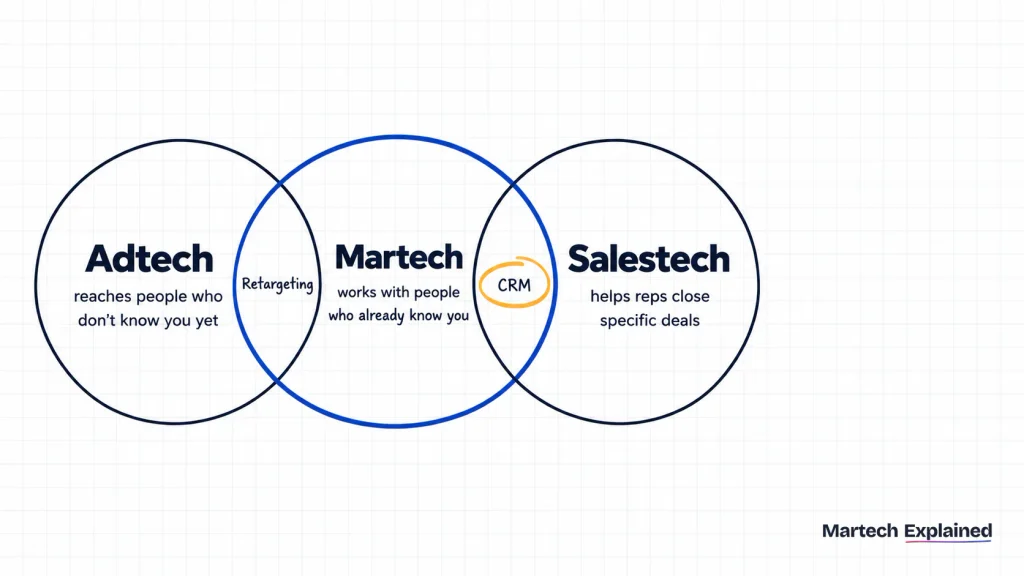
The simplest split is by audience. Adtech reaches people who don’t know you yet, martech works with people who do, and salestech helps sellers close specific deals.
| Martech | Adtech | Salestech | |
|---|---|---|---|
| Main job | Engage and convert known audiences, measure results | Buy and target paid media to reach new audiences | Help sales reps find, contact and close accounts |
| Data it runs on | First-party data you own: emails, site behavior, purchases | Mostly third-party and platform data, bid signals | Contact and account data, deal pipelines |
| Typical buyer | Marketing, growth, lifecycle teams | Media and performance teams, agencies | Sales and revenue operations |
| Examples | HubSpot, Mailchimp, GA4, Webflow | Google Ads, The Trade Desk, Meta Ads | Salesforce Sales Cloud, Outreach, Apollo |
| How it’s priced | Contacts, seats, events or usage | Share of media spend or CPM | Seats, plus data credits |
In practice the lines blur. A CRM sits in both martech and salestech, and retargeting uses martech data to drive adtech spend. What matters more than the label is where your customer data lives and whether each tool can read from it.
How a martech stack fits together
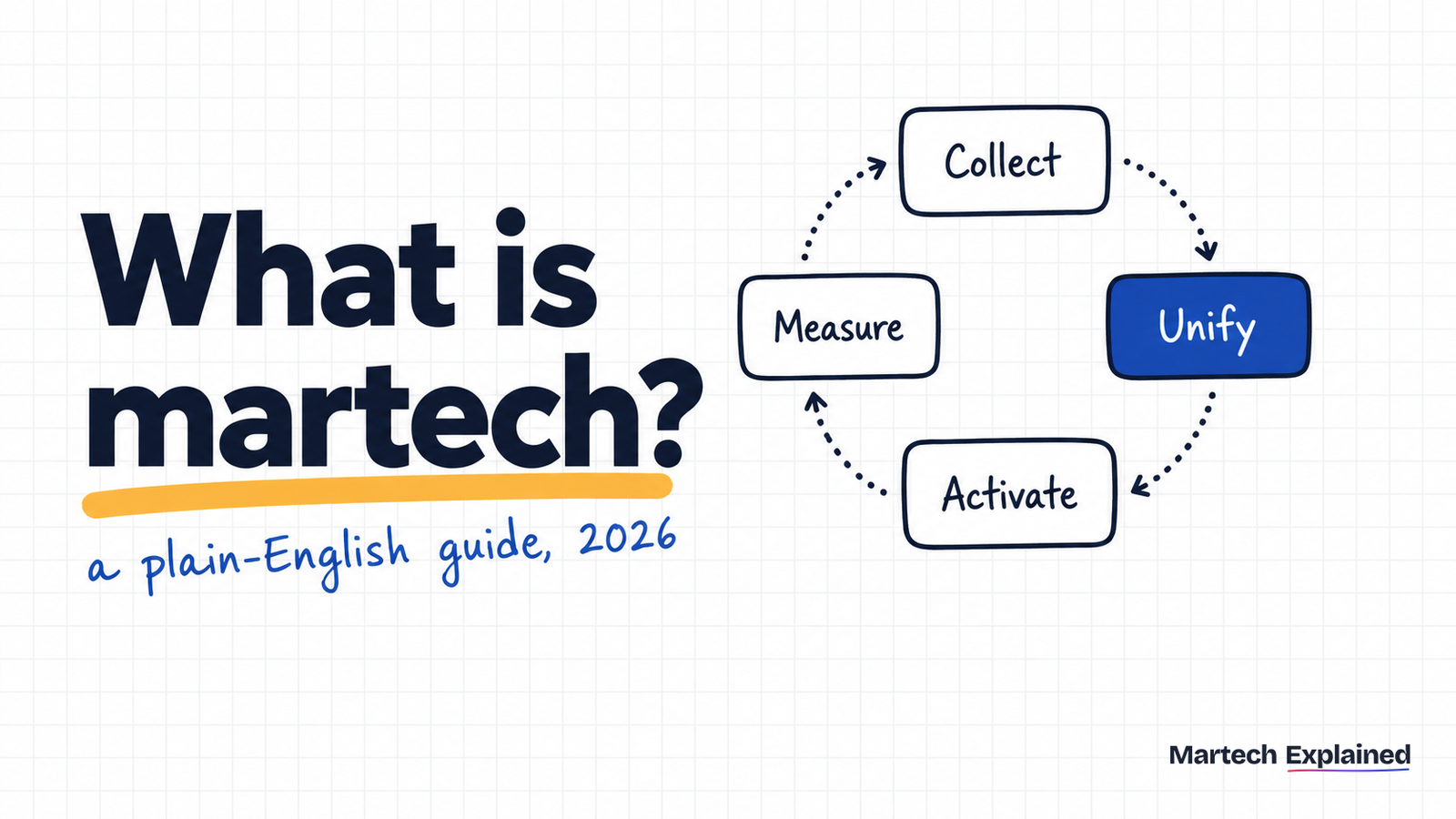
A martech stack is the set of tools a team uses, connected so data flows between them. The tools change from company to company, but the flow is almost always the same: collect, unify, activate, measure.
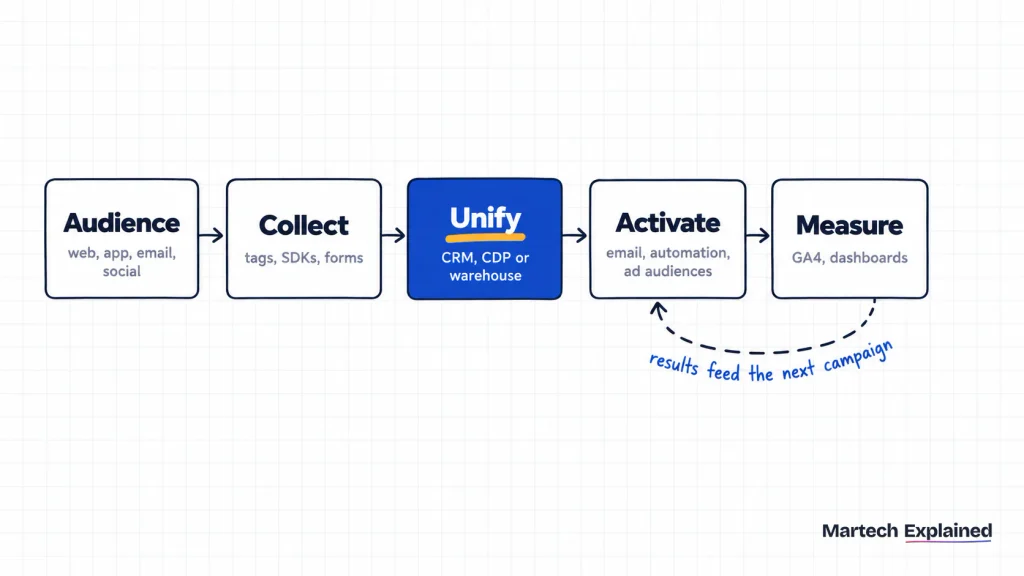
The loop matters more than any single tool. If data doesn’t flow back from “measure” into “activate”, you’re paying for reports nobody acts on. For every layer and the tools in it, see the martech stack explained.
Example stacks by company stage
Costs below are rough estimates, not quotes, and vary with contacts, seats and usage. Check current vendor pricing before you buy.
| Stage | Core tools | Approximate cost per month |
|---|---|---|
| Solo or early startup (1–10 people) | WordPress or Webflow, GA4 + Google Tag Manager, Search Console, HubSpot Free CRM, Brevo or MailerLite, Canva, Buffer | $0–150 |
| Growing team (10–100 people) | HubSpot Marketing Hub Pro or ActiveCampaign, Semrush or Ahrefs, a testing tool like VWO, Hotjar, Looker Studio, Zapier or n8n | $1,000–5,000 |
| Scaling company (100+ people) | Salesforce or HubSpot Enterprise, a CDP or a warehouse (BigQuery, Snowflake) with reverse ETL, an experimentation platform, a BI tool, a customer engagement platform | $20,000+ |
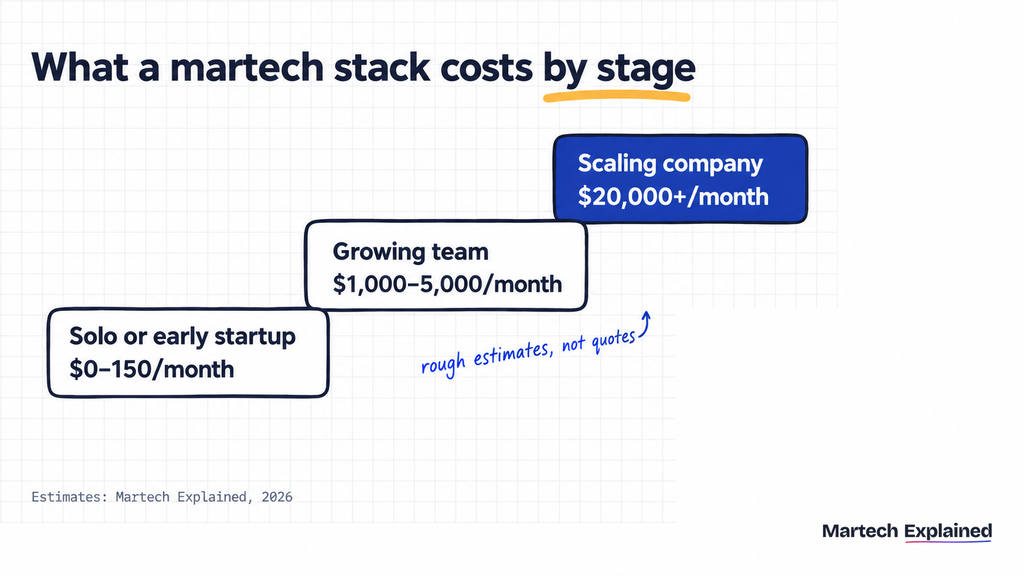
Most of the cost jump between stages isn’t the tools. It’s the people and time needed to connect them. Budget integration work at roughly the same level as licenses in your first year.
From the field
My first stack was an SMS sending tool and an Excel sheet of users. As we added more and more fields, the sheet became overwhelming to manage—a lesson that more customer data only helps when you have a clear plan for what to track and how to use it.
How AI and agents are changing martech in 2026
AI has moved from a feature inside tools to a layer that sits on top of the whole stack. Almost everyone is experimenting, but few teams have it running for real. The agentic marketing guide covers what agents can do today and where they fail.
- Adoption is wide but shallow. 90.3% of marketing organizations use AI agents in some capacity, but only 23.3% have them in full production (MarTech on State of Martech 2026).
- Budgets are following. CMOs now put 15.3% of marketing budgets into AI, and AI-mature companies put in 21.3% (Gartner 2026).
- Most teams aren’t ready. Only 30% of marketing leaders say their AI readiness is mature. 70% say their processes aren’t mature enough to scale AI (same source).
- The early payoff is efficiency. In Gartner’s 2025 survey, 49% of CMOs saw time savings from generative AI, 40% saw cost savings and 22% said it reduced their reliance on agencies (Gartner 2025).
What this means for your stack
- Clean data becomes the product. An AI agent is only as good as the context you give it. Brinker and Riemersma call this “context engineering”: choosing the right data and goals for AI to act on. Messy CRM fields and duplicate contacts now cost you twice.
- Pricing shifts from seats to usage. AI features consume API calls, so more tools bill by credits or runs. Watch for surprise invoices.
- Automation becomes agentic. Classic automation follows rules you wrote (“if a lead downloads X, send Y”). An agent pursues a goal and decides the steps itself. I break down the difference in What Is Agentic Marketing?
- Search is splitting. Buyers now ask ChatGPT, Perplexity and Google’s AI Overviews, not only the blue links. Getting cited there is its own discipline, covered in What Is GEO?
From the field
Using MoEngage’s Merlin AI, I built a case study writer for my content team. It gave us an AI-assisted first draft to review and shape into a finished story.
How to choose martech: a 7-step checklist
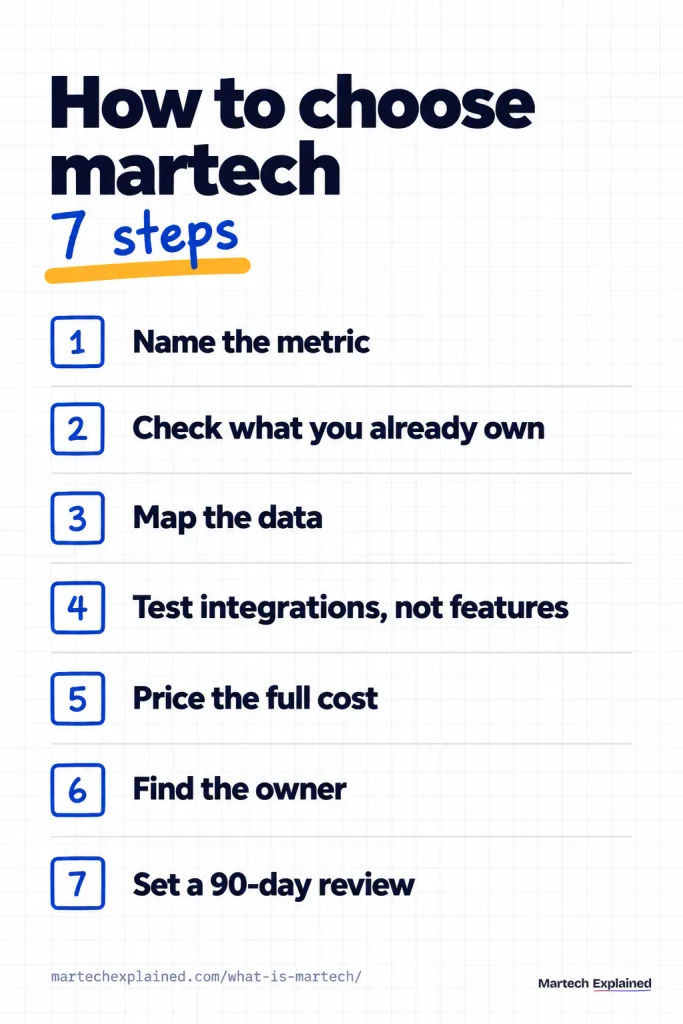
Start from the problem, not the tool. The most common buying mistake is starting with a demo instead of a metric that needs to move.
- Name the metric. Write down the one number this tool should change, such as trial-to-paid conversion or cost per lead, and today’s baseline.
- Check what you already own. With a third of stack capability in use on average, there’s a good chance an existing tool already does it. Ask your current vendors first.
- Map the data. Where will this tool read customer data from, and where will it write back? If the answer is “CSV exports”, keep looking.
- Test integrations, not features. In the trial, connect it to your CRM and analytics on day one. Most failures show up at the joins, not in the demo.
- Price the full cost. Add licenses, usage or AI credits, implementation, training and the admin hours to run it. Ask for the renewal price in writing.
- Find the owner. Every tool needs one named person who is accountable for adoption. No owner, no purchase.
- Set a 90-day review. Decide up front what result keeps the tool and what gets it cancelled.
Questions to ask every vendor
- What does pricing look like at 2x and 5x our current contacts or usage?
- Which of our existing tools do you have native integrations with, and who maintains them?
- How do we export all our data if we leave?
- Which AI features are included, and which are billed per use?
- Where is data stored, and are you GDPR and SOC 2 compliant?
- Can we talk to a customer our size who’s used you for 12+ months?
6 common martech mistakes (and how to avoid them)
| Mistake | Why it hurts | What to do instead |
|---|---|---|
| Buying for features you’ll “grow into” | You pay for the top tier for years while using the basics | Buy the tier you need now and negotiate upgrade pricing into the contract |
| No single source of truth for customers | Every tool has a different contact count, so no report matches | Pick one system of record (usually the CRM) and sync everything to it |
| Skipping tracking governance | Events named three different ways make analytics useless | Write a tracking plan with event names and properties before you tag anything |
| Tool sprawl through free trials | Each team signs up for its own tool and data ends up in silos | Keep one shared tool inventory with owner, cost and renewal date |
| Treating AI as a plug-in | Agents on top of messy data produce confident, wrong output | Clean and document your core data before scaling AI features |
| Ignoring consent and privacy | Fines, blocked tracking and broken ad audiences | Use a certified consent management platform and set up Google Consent Mode v2 |
From the field
I’ve seen the same customer action logged under three different event names. When teams tried to connect marketing touchpoints to revenue, the events didn’t line up, leaving attribution reports inconsistent and making it hard to tell which channels were contributing.
Frequently asked questions
What does martech stand for?
Martech stands for marketing technology. It means the software marketing teams use to manage customer data, create and deliver content, run campaigns across channels and measure results. Email platforms, analytics tools, CRMs and website builders are all martech.
What is an example of martech?
Google Analytics 4 is a common example: it tracks what visitors do on your website. Others include Mailchimp for email, HubSpot for marketing automation and CRM, Semrush for SEO and WordPress for publishing content.
What is the difference between martech and adtech?
Adtech helps you buy paid media to reach people who don’t know you yet, often using third-party data. Martech helps you engage and convert people who already know you, using first-party data you own. Many teams use both, connected through shared audiences.
What is a martech stack?
A martech stack is the set of marketing tools a company uses, connected so customer data flows between them. A small business stack might be WordPress, GA4, a free CRM and an email tool. An enterprise stack can include dozens of tools plus a data warehouse.
How many martech tools are there?
The 2026 Marketing Technology Landscape counts 15,505 products. That’s up from about 150 in 2011, but only 0.79% more than in 2025, the slowest growth in 15 years.
Is martech the same as marketing automation?
No. Marketing automation is one category within martech. It covers tools that run campaigns automatically based on rules, such as sending an email when someone downloads a guide. Martech also includes analytics, content, data, social and advertising tools. For how it works, see what marketing automation is.
What jobs are there in martech?
Common roles include marketing operations manager, martech manager or architect, marketing automation specialist, CRM manager and web or marketing analyst. These roles mix marketing knowledge with skills in data, integrations and tool administration.
The bottom line
Martech is simply the software that lets marketing collect data, act on it and prove the result. The market has stopped growing in product count, budgets are flat, and AI is changing how the tools work. That makes this a good time to use what you already have before buying more.
If you’re building your first stack, start with the martech stack explained, then keep the martech glossary handy for the jargon.
Get the next guide in your inbox
One email a week: the new guides, one tool worth knowing and one number that matters.
Sources
- 2026 Marketing Technology Landscape Supergraphic, Scott Brinker, chiefmartec (via CustomerThink), May 2026
- 2025 Marketing Technology Landscape Supergraphic, chiefmartec, May 2025
- Marketing Technology Landscape Supergraphic (2016), chiefmartec, March 2016
- Gartner 2026 CMO Spend Survey, Gartner press release, May 2026
- Gartner CMO Spend Survey: consumption-based martech and paid media, Chief Marketer, 2026
- Gartner 2025 CMO Spend Survey, Gartner press release, May 2025
- Global martech spending will reach $148 billion in 2024, Forrester
- Marketers are only using one-third of their stack’s capability, MarTech, on Gartner’s 2023 Martech Survey
- Martech 2026: AI drives a major industry reset, MarTech, on the State of Martech 2026 report
- Scott Brinker, Wikipedia